





Easy & Hard Tongue Twisters in English For Kids


During the developmental years of your child, you may worry about their english pronunciation and speech clarity. In the journey of language development, children often face challenging sounds and tricky pronunciation patterns. One fun and effective way to support this learning is through tongue twisters in English. These silly-sounding phrases may seem like a game, but they actually help children speak more clearly, improve pronunciation, and build confidence.
This blog is perfect for parents, teachers, and young learners who want to explore the world of tongue twisters. Whether you’re looking for easy tongue twisters in English for kids or more difficult ones to challenge older children, we’ve got you covered.
In this blog, we’ll explain what English tongue twisters are, explore their types and benefits, and share a wide range of short, funny, easy, and hard tongue twisters in English. Get ready to twist your tongue and have some fun while learning!
What Are Tongue Twisters in English?
Tongue twisters in English are fun and tricky phrases made up of similar-sounding words that are hard to say quickly and correctly. They are often used as a playful way to practise speaking clearly and improve pronunciation. Even speech therapists use them to help people with pronunciation and fluency. They also help children develop better language skills and sound awareness. A simple example is: “She sells seashells by the seashore.”
The origin of English tongue twisters goes back hundreds of years. They have been part of English-speaking cultures as both a form of wordplay and a tool for speech training. In fact, the famous seashell tongue twister is believed to be inspired by Mary Anning, a fossil collector from the 1800s.
There are different types of tongue twisters in English. Some repeat the same sounds, like “Peter Piper picked a peck of pickled peppers.” Others use rhyming words or tricky letter combinations. Some are very short, while others are longer and more challenging. Some focus on repeating sounds like “s”, “t”, or “r”, while others play with rhythm and rhyme.
They help children and adults improve their speech, build confidence in speaking, and have lots of fun along the way!
Must Buy: Key2Practice Children Books
Benefits of Tongue Twisters for Kids
Funny Tongue Twisters in English for Kids are not only fun but also a great learning tool for children. They offer several educational, linguistic, and developmental benefits that help kids grow into confident speakers.
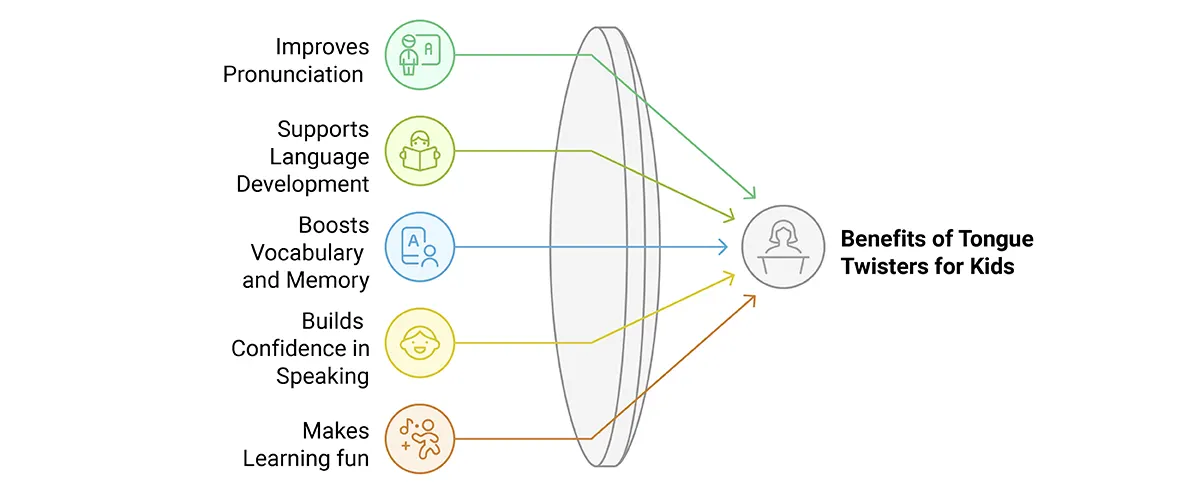
1. Improves Pronunciation
These Tongue Twisters are filled with similar sounds and tricky word combinations. Saying them out loud helps children learn how to move their mouths and tongues correctly, improving their pronunciation and speech clarity.
2. Supports Language Development
These phrases often use patterns like rhyme, repetition, and rhythm. This helps young learners understand how words sound and fit together, building a strong foundation in the English language.
3. Boosts Vocabulary and Memory
Learning English Tongue Twisters introduces children to new words and sounds. Repeating them also exercises memory, helping children remember sentence structure and pronunciation over time.
4. Builds Confidence in Speaking
Practising Tongue Twisters regularly helps children speak more fluently and with confidence—whether they’re reading aloud, performing in school, or simply chatting with friends.
5. Makes Learning Fun
Because tongue twisters are silly and playful, they make speech practice enjoyable. This keeps children interested and encourages them to keep learning.
Also Learn: Fruits Name in English for Kids
Easy Tongue Twisters for Kids
Here are some easy and funny tongue twisters for kids that young children can try. These are great for practising simple sounds and building confidence in speaking.
| No. | Short Tongue Twisters | Meaning | Sound Focus |
| 1 | Red lorry, yellow lorry | It’s tricky to say these two colours quickly. | The repeating “r” and “l” sounds. |
| 2 | Green glass globes glow greenly | Glowing green glass balls are hard to say fast. | The repeating “g” and “gl” sounds. |
| 3 | Kitty caught the kitten in the kitchen | A cat found a kitten in the kitchen. This is a playful phrase about cats in the kitchen. | The “k” and “t” sounds. |
| 4 | Black bug’s blood | This funny tongue twister for kids is all about a little insect. | The “b” and “bl” blend. |
| 5 | A big brown bear bought butter and beans. | A shopping bear is a fun idea for kids. | Repeating “b” sounds. |
| 6 | Three free throws | Great for basketball fans, but hard to say fast! | “Th” and “fr” sounds. |
| 7 | I scream, you scream, we all scream for ice cream! | Everyone loves ice cream—especially in this rhyme. | “s” and “scr” sounds. |
| 8 | Fuzzy Wuzzy was a bear | A classic rhyme about a not-so-fuzzy bear. | The repeating “f” and “w” sounds. |
| 9 | Chickens in the kitchen | This silly line is great for younger learners. | “ch” and “k” sounds. |
| 10 | Cows in the cornfield | This paints a funny picture of cows being naughty. | “c” and “k” sounds. |
| 11 | Ten tiny turtles took a trip | A group of turtles went travelling. This one is a funny one for kids who love animals. | The “t” sound. |
| 12 | A happy hippo hopped | Zebras running in zigzag patterns. A short and cheerful tongue twister, perfect for young speakers. | Repeating “h” sounds. |
| 13 | Penny’s pretty pink piggy bank | A tongue twister about a colourful money box. | “p” and “pr” sounds. |
| 14 | Zippy zebras zigzagged | Zebras running in zigzags can be hard to say. | “z” and “zz” sounds. |
| 15 | Two tiny tigers taking tea | Even tigers enjoy tea in this silly sentence. | “t” and “ti” sounds. |
| 16 | Bobby brings bright blue balloons | Balloons for a party make this fun to say. | “b” and “bl” sounds. |
| 17 | Simple Simon sat on a stump | A traditional rhyme with a seated Simon. | “s” and “st” sounds. |
| 18 | Nina’s nanny napped nicely. | A nanny took a peaceful nap. A calm and quiet line for young learners. | “n” and “nn” sounds. |
| 19 | Silly sheep sleep soundly | A bedtime twist on tongue twisters! | “s” and “sh” sounds. |
| 20 | Jumping jellybeans jiggled | A bouncy line that’s fun to say and imagine. | “j” and “g” sounds. |
Also Learn: Animals Name in English for Kids
Hard Tongue Twisters for Older Kids
As kids grow more confident with language, they enjoy bigger challenges. These hard tongue twisters help sharpen pronunciation, boost memory, and make speaking exercises extra fun.
| No | Hard Tongue Twister | Meaning | Sound Focus |
| 1 | Peter Piper picked a peck of pickled peppers. | Peter Piper collected a large amount of pickled peppers. | Repeating “p” and “ck” sounds |
| 2 | How much wood would a woodchuck chuck if a woodchuck could chuck wood? | A playful question about how much wood an animal can move. | “w” and “ch” sounds |
| 3 | She sells seashells by the seashore. | A woman sells seashells near the ocean. | “s” and “sh” sounds |
| 4 | Betty Botter bought some butter, but the butter was bitter, so she bought better butter. | Betty didn’t like bitter butter and got a better one instead. | “b” and “tt” sounds |
| 5 | A proper copper coffee pot popped on papa’s polished plate. | A neat copper kettle was placed on a fancy plate. | “p” and “c/k” sounds |
| 6 | Six slippery snails slid silently southward, slowly squirming on the sand. | A group of snails crawled slowly and quietly towards the sea. | “s” and “sl” sounds |
| 7 | Which witch wished which wicked wish? | A tricky phrase about witches and their wishes. | “w” and “ch” sounds |
| 8 | Fred fed Ted bread, and Ted fed Fred bread. | Fred and Ted are feeding each other bread. | “f”, “t”, and “br” sounds |
| 9 | Rory the warrior and Roger the worrier were reared wrongly in a rural brewery. | Rory and Roger had a confusing childhood in a brewery. | “r” and “w” sounds |
| 10 | I slit the sheet, the sheet I slit, and on the slitted sheet I sit. | A humorous line about cutting a sheet and sitting on it. | “sl” and “sh” sounds |
| 11 | Brisk brave brigadiers brandished broad bright blades, blunderbuses, and bludgeons—balancing them badly. | Soldiers show off their shiny swords. | “br” and “bl” sounds |
| 12 | The great Greek grape growers grow great Greek grapes. | A tongue twister about grape farmers in Greece. | “gr” and “g” sounds |
| 13 | If two witches were watching two watches, which witch would watch which watch? | A confusing line about witches and their watches. | “w” and “ch” sounds |
| 14 | Can you can a can as a canner can can a can? | A question about whether you can preserve like a professional. | “c” and “n” sounds |
| 15 | Nine nice night nurses nursed neatly in New York’s night ward. | A group of nurses is working during the night. | “n” and “ni” sounds |
| 16 | Pad kid poured curd, pulled cold corn, and packed it properly. | A boy named Pad did several cold food-related tasks quickly. | “p”, “k”, and “c” sounds |
| 17 | Top chopstick shops stock top-class chopsticks for chopstick champions. | The best shops sell the best chopsticks. | “ch” and “st” sounds |
| 18 | A skunk sat on a stump and thunk the stump stunk, but the stump thunk the skunk stunk. | A skunk thinks the tree stump smells bad. | “st” and “sk” sounds |
| 19 | Thin sticks and thick bricks break tricky traps in thick thickets. | A comparison between light sticks and heavy bricks. | “th” and “br” sounds |
| 20 | Lesser leather never weathered wetter weather better than the leather Lenny left. | Poor-quality leather isn’t good in wet weather. | “l”, “w”, “th”, and “le” sounds |
Also Learn: Flowers Name in English for Kids
Tips to Practise Tongue Twisters in English with Kids
Practising tongue twisters in English can be a fun and valuable way to improve speech, but kids may need some guidance at first. Here are some parent- and teacher-friendly tips to help make the most of each session:
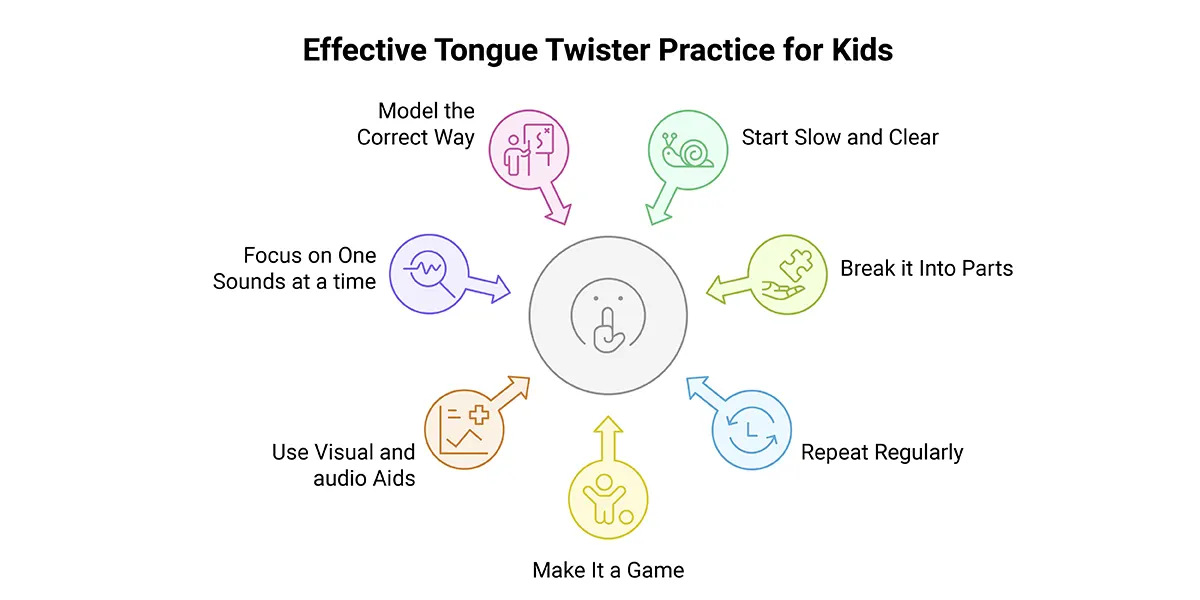
1. Start Slow and Clear
Begin by reading the tongue twister slowly and clearly. Focus on correct pronunciation rather than speed. This helps children hear and understand the individual sounds.
2. Break It Into Parts
Divide longer tongue twisters into smaller chunks. Practise each phrase before putting it all together. This makes them less overwhelming and easier to learn.
3. Repeat Regularly
Encourage daily repetition. Practising tongue twisters for 5–10 minutes a day builds confidence, sharpens memory, and improves fluency over time.
4. Make It a Game
Turn practice into a challenge—use a timer, set goals, or award small prizes. A competitive element keeps kids engaged and excited.
5. Use Visual and Audio Aids
Print the list of tongue twisters on colourful cards or use audio recordings. Multisensory learning boosts recall and keeps things interesting.
6. Focus on One Sound at a Time
Choose English tongue twisters based on specific sounds like “sh”, “ch”, or “th”. This helps target problem areas in speech development.
7. Model the Correct Way
Say the tongue twister first as an example. Kids often improve by listening and imitating how adults speak.
Also Learn: Water Animals Name in English and Hindi for Kids
Conclusion
Tongue twisters in English are more than just playful phrases—they’re powerful tools that support speech clarity, listening skills, and language development in children. From easy tongue twisters for kids to more challenging and difficult ones, they help young learners strengthen their pronunciation, memory, and confidence in a fun and engaging way.
Whether you’re a parent looking to boost your child’s speaking skills or a teacher planning interactive classroom activities, English tongue twisters offer a creative solution. With regular practice, children not only improve their fluency but also enjoy a sense of achievement with every clear recital.
To make the most of this learning experience, we encourage you to explore our specially curated books for children. They’re filled with the best tongue twisters in English, short and long, easy and hard—perfect for young learners at every stage. Let the fun and learning continue beyond the screen!
FAQs
How do tongue twisters support language development in children?
English Tongue twisters challenge kids to pronounce similar sounds quickly, helping them improve diction, rhythm, and fluency in spoken language.
Why are tongue twisters useful for kids?
They help improve speech clarity, develop listening skills, and build confidence in speaking through playful practice.
At what age can kids start practising tongue twisters?
Children as young as 4 or 5 can start with short, easy tongue twisters. Older kids can try harder ones as they grow.
How often should kids practise tongue twisters?
A few minutes a day is ideal. Consistent practice helps build stronger language skills over time.
Are tongue twisters only for English learners?
No. English Tongue Twisters benefit all children by improving articulation, whether English is their first language or not.
Can tongue twisters help children with speech delays or articulation issues?
Yes, when used gently and with guidance, English Tongue Twisters can support speech therapy by strengthening mouth muscles and improving sound pronunciation in a fun way.


