

Ohm’s Law – Definition, Experiment, Derivation, and Examples
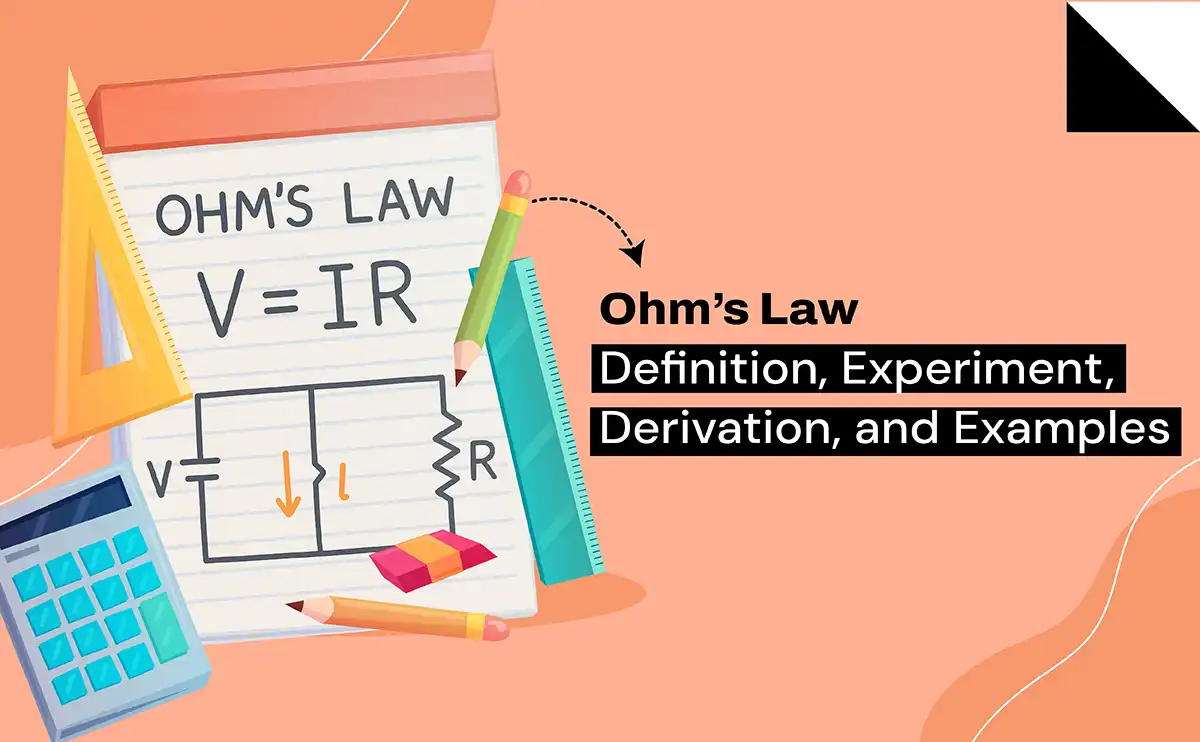
Ohm’s Law is one of the most important and fundamental laws in the study of electricity. It helps us understand how voltage, current, and resistance are related to each other in an electric circuit. This law explains that the current flowing through a conductor is directly proportional to the voltage applied across it, provided the resistance remains the same. It allows us to calculate any of the three quantities, voltage, current, or resistance, when the other two are known.
In this detailed explanation, you will learn everything about Ohm’s Law, including its definition, formula, graph, triangle, units, experiment, applications, limitations, and examples. Understanding this concept is essential for students of ohm’s law class 10 as it forms the foundation of electric circuit studies.
What is Ohm’s Law
Ohm’s Law is a basic law in physics that shows the relationship between voltage, current, and resistance in a circuit.
According to the ohm’s law definition, the current passing through a conductor is directly proportional to the potential difference (voltage) across its ends, provided the temperature and physical conditions of the conductor remain constant.
In simple words, if you increase the voltage, the current also increases, and if you reduce the voltage, the current decreases, assuming resistance does not change. This simple relationship helps in understanding what is ohm’s law and how it applies to real electrical circuits.
Ohm’s Law Formula
The Ohm’s Law Formula is the mathematical expression that connects voltage (V), current (I), and resistance (R). It is written as:
[V = I x R]
Where:
- V is the voltage, measured in volts (V).
- I is the current, measured in amperes (A).
- R is the resistance, measured in ohms (Ω).
The equation can be rearranged as:

These forms help to find any one quantity when the other two are known. For example, if voltage and resistance are given, current can be calculated easily. This simple equation makes Ohm’s Law one of the most useful tools in electrical calculations.
Must Buy: Gurukul by Oswal CBSE Class 10 Sample Papers
Ohm’s Law Graph
The Ohm’s Law Graph visually represents the direct relationship between voltage and current.
| Axis | Quantity | Description |
| X-axis | Voltage (V) | Independent variable |
| Y-axis | Current (I) | Dependent variable |
When we plot voltage on the X-axis and current on the Y-axis, the graph for a metallic conductor gives a straight line passing through the origin. This straight line shows that the current increases uniformly with voltage, proving that both are directly proportional.
The slope of this line represents the resistance (R) of the conductor. A steeper slope means higher resistance, and a flatter slope means lower resistance.
For ohmic conductors such as metals, the graph is a straight line. For non-ohmic materials such as diodes or filament lamps, the graph curves because their resistance changes with temperature.
Ohm’s Law Unit
The SI units used in Ohm’s Law are as follows:
| Quantity | Symbol | SI Unit | Meaning |
| Voltage | V | Volt (V) | Electrical potential difference |
| Current | I | Ampere (A) | Flow of electric charge |
| Resistance | R | Ohm (Ω) | Opposition to current flow |
From the Ohm’s Law Formula,
This means that a conductor has a resistance of one ohm if a current of one ampere flows through it when a potential difference of one volt is applied across it.
Ohm’s Law Triangle
The Ohm’s Law Triangle is a simple visual tool that helps students remember the three formulas easily.
| Triangle Layout | Explanation |
| V at the top, I and R at the bottom corners | To find: • Voltage (V): Cover V → (V = I × R) • Current (I): Cover I → (I = V ÷ R) • Resistance (R): Cover R → (R = V ÷ I) |
This triangle is very useful for ohm’s law class 10 students during exams or practicals. It acts as a quick mnemonic to recall the Ohm’s Law Formula without confusion.
Applications of Ohm’s Law
Ohm’s Law is not just theoretical. It has practical and real-world applications in many areas of electrical and electronic work. Here are some important Applications of Ohm’s Law:
- Designing Circuits: Engineers and electricians use this law to design circuits by selecting proper voltage and resistance to control current flow.
- Checking Electrical Components: It helps in testing whether resistors and wires are functioning correctly by comparing actual and expected current values.
- Determining Power: With Ohm’s Law, electrical power can be calculated using (P = V × I).
- Household Appliances: Used in calculating safe current ratings for bulbs, fans, and heaters.
- Automobiles and Gadgets: It helps regulate battery and alternator performance in cars and controls circuit functions in electronic devices.
- Academic Experiments: Used in laboratories for understanding how resistance affects current flow and voltage.
From classrooms to industries, Ohm’s Law remains essential in understanding how electrical circuits behave.
Ohm’s Law Experiment
This experiment helps to verify Ohm’s Law and understand how voltage and current are related in a circuit.
Apparatus Required
- A resistor (R)
- Ammeter (A)
- Voltmeter (V)
- Battery or DC power source
- Rheostat (variable resistor)
- Key or switch
- Connecting wires
Circuit Setup
- Connect the components in series: battery, key, ammeter, and resistor.
- Connect the voltmeter across the resistor to measure the voltage.
- Insert a rheostat in the circuit to vary the voltage and current.
Procedure
- Close the key to start the circuit.
- Note the current from the ammeter and voltage from the voltmeter.
- Vary the resistance using the rheostat and take several readings of V and I.
- Plot a graph between V (on X-axis) and I (on Y-axis).
Observation
The graph between voltage and current is a straight line through the origin. This shows that the two quantities are directly proportional, confirming Ohm’s Law.
Conclusion
Hence, Ohm’s Law is verified as (V ∝ I) for a conductor, provided temperature and physical conditions remain constant.
Ohm’s Law Examples
Let us solve some simple ohm’s law example problems to understand the concept better.
Example 1:
Find the current flowing through a 6 Ω resistor when a voltage of 12 V is applied.
So, the current is 2 amperes.
Example 2:
A 10 Ω resistor is connected to a 5 V battery. Find the current through it.
The current through the resistor is 0.5 amperes.
Example 3:
A bulb uses a current of 2 A when connected to a 220 V supply. Calculate the resistance.
Therefore, the resistance of the bulb is 110 ohms.
Example 4:
If 3 A of current flows through a 20 Ω resistor, find the voltage across it.
[
V = I × R = 3 × 20 = 60 V
]
The voltage across the resistor is 60 volts.
These examples clearly show how Ohm’s Law can be applied to everyday problems in electrical circuits and make calculations simple.
Limitations of Ohm’s Law
Although Ohm’s Law is extremely useful, it does not apply in every situation. The main limitations are:
- It applies only to ohmic conductors that have constant resistance.
- It fails for materials where resistance changes with temperature, light, or pressure.
- Non-linear devices such as diodes, transistors, and thermistors do not obey Ohm’s Law.
- It is not valid when the physical properties of the material change, such as melting or heating.
Therefore, Ohm’s Law is valid only under specific and controlled conditions.
Tips to Remember Ohm’s Law
Here are some simple study tips to help remember Ohm’s Law quickly:
- Use the Triangle: Visualise the Ohm’s Law Triangle to recall formulas easily.
- Remember the Relation: Voltage pushes current through resistance.
- Practise Problems: Solve one or two numerical examples daily.
- Visualise the Graph: A straight line between V and I means constant resistance.
- Memorise Units: One Volt equals one Ampere multiplied by one Ohm.
These tips make Ohm’s Law easier to study and apply for ohm’s law class 10 students.
Conclusion
Ohm’s Law is a key principle in the study of electric circuits. It defines a simple relationship between voltage, current, and resistance and helps in analysing and designing electrical systems. From basic circuit analysis to advanced electronic applications, this law plays a vital role in understanding how electricity behaves.
Even though Ohm’s Law has limitations and is not valid for all materials, it remains the foundation of electrical and electronic engineering. Understanding this law helps students and professionals alike to calculate, predict, and control current flow in a circuit efficiently.
FAQs
What is the main statement of Ohm’s Law?
It states that the current through a conductor is directly proportional to the voltage across it, provided the temperature remains constant.
Who discovered Ohm’s Law?
It was discovered by Georg Simon Ohm in 1827.
What is the unit of resistance?
The SI unit of resistance is Ohm (Ω).
Is Ohm’s Law applicable to all materials?
No, it applies only to ohmic materials where resistance does not change with temperature or current.
Why is Ohm’s Law important?
Because it helps in understanding and designing electric circuits and calculating unknown electrical quantities with ease.
