



Understanding Heron’s Formula: Common Mistakes and How to Avoid Them


In geometry, triangles are among the most common and important shapes. From architecture to art, their role is everywhere. But what if we need to find the area of a triangle when its height is unknown? This is where heron’s formula comes to the rescue. It provides a direct way to calculate the area using only the lengths of the three sides.
This formula is extremely helpful when measuring irregular shapes or land plots, where the perpendicular height cannot be measured easily. Learning this concept is not only essential for exams but also for understanding practical geometry better.
In this blog, we will clear A-Z of heron’s formula for you. Continue reading!
- ▪ What is Heron’s Formula?
- ▪ History of Heron's Formula
- ▪ Heron’s Formula for Triangles
- ▪ How to Find the Area Using Heron’s Formula?
- ▪ Heron’s Formula for Equilateral Triangle
- ▪ Heron’s Formula for Scalene Triangle
- ▪ Heron’s Formula for Isosceles Triangle
- ▪ Applications of Heron’s Formula
- ▪ Solved Examples: Practice Questions and Answers
- ▪ Tips to Master Heron’s Formula
- ▪ Common Mistakes Students Make
- ▪ How to Avoid These Mistakes
- ▪ Conclusion
- ▪ FAQs
What is Heron’s Formula?
Heron’s formula is used to calculate the area of a triangle when you know all three sides. It does not require height, which makes it very useful in complex cases.
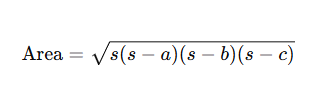
The formula is:

Here:
- a, b, and c are the lengths of the sides
- s is the semi-perimeter, given by the semi perimeter of triangle formula
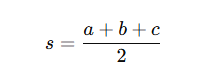
The semi-perimeter is half of the triangle’s perimeter.
This method can be applied to any triangle – equilateral, isosceles, or scalene.
Example:
If a triangle has sides of 6 cm, 8 cm, and 10 cm,
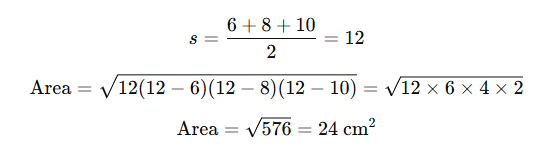
This simple example shows how easily you can find the area without knowing the height.
Also Read: How to Solve CBSE Class 9 Worksheets Step by Step
History of Heron’s Formula
Mathematics has deep roots in history, and heron’s formula is no exception. It was developed by Hero (Heron) of Alexandria, a Greek engineer, mathematician, and inventor who lived around 10–70 AD.
Key Points about Heron of Alexandria
- Contributions: He worked on geometry, mechanics, and measurement tools.
- Book – Metrica: His famous work Metrica contains the derivation of this formula.
- Purpose: The formula was originally used to measure land areas in ancient construction and architecture.
- Legacy: His discovery is still taught to school students across the world and helps to prove herons formula with simple algebraic steps.
Heron’s understanding of shapes was far ahead of his time, and his formula remains one of the most elegant results in geometry.
Heron’s Formula for Triangles
Before we look at each type of triangle, it is important to remember that heron’s formula applies to all triangles, regardless of their shape or size.
Why It’s So Useful
- It works even when the height cannot be measured.
- It only needs the side lengths.
- It provides accurate results for any triangle type.
The three types of triangles where this formula is used include:
| Type of Triangle | Properties | Can Heron’s Formula Be Used? |
| Equilateral | All sides equal | Yes |
| Isosceles | Two sides equal | Yes |
| Scalene | All sides different | Yes |
Now let us understand how to use it in practice.
How to Find the Area Using Heron’s Formula?
To calculate the area correctly, follow these simple steps.
Step-by-Step Method
1. Write down the side lengths – label them as a, b, and c.
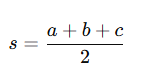
2. Calculate the semi-perimeter (s)
3. Substitute into the formula
4. Simplify the values under the root sign.
5. Find the square root to get the final area.
6. Write the answer with units (e.g. cm²).
Example:
Find the area of a triangle with sides 7 cm, 8 cm, and 9 cm.
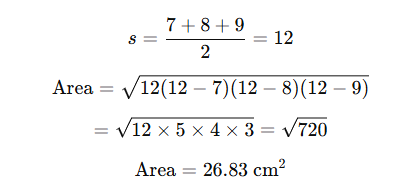
Hence, the area of triangle using heron’s formula is 26.83 cm².
Heron’s Formula for Equilateral Triangle
When all sides of a triangle are equal, it is called an equilateral triangle.
In this case, heron’s formula becomes simpler.
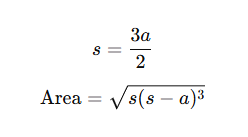
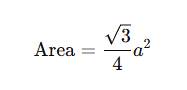
Formula Derivation
If all sides are a, then
Example
If each side is 10 cm,
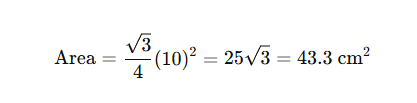
This version of heron’s formula for equilateral triangle is often taught as a shortcut.
Heron’s Formula for Scalene Triangle
A scalene triangle has all sides of different lengths. It requires direct application of heron’s formula without any simplification.
Example
Let the sides be 5 cm, 6 cm, and 7 cm.

This shows how easily heron’s formula adapts to all shapes of triangles.
Heron’s Formula for Isosceles Triangle
An isosceles triangle has two equal sides. For such triangles, the same heron’s formula can be used, but calculations must account for repeated sides.
Example
If sides are 10 cm, 10 cm, and 12 cm,
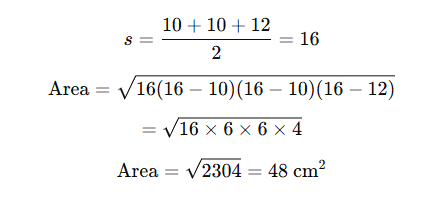
Hence, the area of this isosceles triangle is 48 cm².
Applications of Heron’s Formula
Though it is often studied in classrooms, heron’s formula has many practical uses.
Here are ten common real-world applications presented in a table for easy reference.
| No. | Application | Explanation |
| 1 | Land Surveying | Helps to find the area of irregular land plots where height cannot be measured. |
| 2 | Architecture | Used to design triangular roofs, trusses, and windows. |
| 3 | Engineering | Important in structural design to find areas of triangular supports. |
| 4 | Navigation | Used in mapping triangular distances between ships or landmarks. |
| 5 | Computer Graphics | Calculates the area of triangular mesh elements in 3D models. |
| 6 | Astronomy | Helps find the area between stars or planets forming a triangle. |
| 7 | Geography | Used to measure territories or plots on maps with triangular boundaries. |
| 8 | Physics | Helpful in finding work done in motion along triangular paths. |
| 9 | Art and Craft | Enables accurate drawing of geometric patterns. |
| 10 | Education | Teaches mathematical reasoning and formula application. |
These applications show how widely heron’s formula for triangle is used in real life.
Also Read: Importance of NCERT Books for Class 9 Exam Success
Solved Examples: Practice Questions and Answers
Let us practise some solved examples to understand how to use heron’s formula correctly.
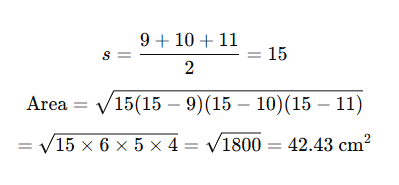
Example 1
Find the area of a triangle with sides 9 cm, 10 cm, and 11 cm.
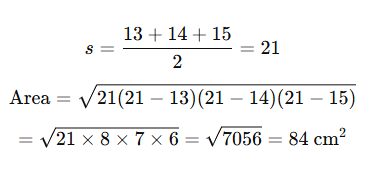
Example 2
Find the area of a triangle with sides 13 cm, 14 cm, and 15 cm.
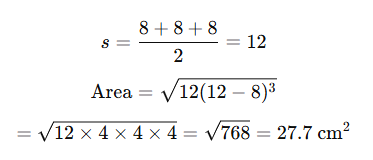
Example 3
Find the area of an equilateral triangle of side 8 cm.
Try Yourself
Find the area of a triangle with sides 5 cm, 12 cm, and 13 cm using heron’s formula.
Tips to Master Heron’s Formula
Before learning the advanced applications, students should focus on building accuracy.
Here are some effective tips to help you master heron’s formula easily.
- Memorise the pattern of the formula before practising questions.
- Always find the semi-perimeter first to avoid confusion.
- Check the triangle inequality rule to ensure the sides can form a triangle.
- Simplify in steps instead of doing all operations together.
- Draw a figure to understand the relationship between sides.
- Keep calculations neat by aligning each step properly.
- Avoid early rounding, especially under square roots.
- Practice with different triangle types (scalene, equilateral, and isosceles).
- Understand the derivation to strengthen conceptual clarity.
- Use it in daily geometry problems to build confidence.
Following these will make the topic more intuitive and less mechanical.
Common Mistakes Students Make
While applying heron’s formula, students often make errors that lead to wrong results. Recognising them early can improve accuracy.
- Forgetting to calculate or write the semi-perimeter correctly.
- Substituting side lengths incorrectly.
- Ignoring the square root in the final formula.
- Rounding values too soon and losing precision.
- Mixing up units such as cm and m in the same problem.
Awareness of these mistakes helps students correct them during practice sessions.
How to Avoid These Mistakes
To use heron’s formula efficiently, focus on accuracy and consistency.
Here are some ways to prevent common errors:
- Write all given sides clearly before starting.
- Recheck the semi-perimeter calculation before substituting values.
- Include the square root in the final step without skipping it.
- Simplify gradually rather than in one big step.
- Keep all measurements in the same unit throughout the calculation.
These small habits can make a big difference in accuracy and understanding.
Conclusion
Heron’s formula is not just a mathematical expression; it is a clever tool that connects geometry, logic, and problem-solving. It teaches accuracy and strengthens your understanding of shapes.
By practising regularly, you can quickly learn to apply it in exams and real-life problems. Remember, consistent practice will help you calculate the area of triangle using heron’s formula with confidence and speed. Mastering this formula lays a solid foundation for advanced geometry topics.
FAQs
Who was Heron of Alexandria?
He was a Greek mathematician and engineer who derived heron’s formula to measure areas using side lengths.
Can Heron’s Formula be used for all triangles?
Yes, it works for equilateral, isosceles, and scalene triangles.
What is the formula for a semi-perimeter?
It is given by the semi perimeter of triangle formula, ( s = (a+b+c)/2 ).
What is the main advantage of Heron’s Formula?
It helps calculate area even when the height of the triangle is not known.
How can we easily prove Heron’s Formula?
You can prove herons formula using the Pythagoras theorem and basic algebraic relationships.


