



Cubes 1 to 30: Values, Table, Chart & Tricks to Remember


Cubes 1 to 30: You’ve probably come across the term cube while flipping through your Maths textbook. If you’re not sure what it means, don’t worry! In simple words, a cube is the result of multiplying a number by itself three times. For example, the cube of 2 is 2 × 2 × 2 = 8.
Memorising cube values is super helpful in simplifying equations quickly, especially in exams, be it ICSE, CBSE, or competitive exams. In this blog, we’ll share the value of cubes 1 to 30, along with some smart tips and tricks to help you remember them easily.
- ▪ Cubes 1 to 30
- ▪ List of All Cubes from 1 to 30
- ▪ Cubes Chart 1 to 30
- ▪ Cubes from 1 to 30 - Even Numbers
- ▪ Cubes from 1 to 30 - Odd Numbers
- ▪ How to Calculate Values of Cubes 1 to 30?
- ▪ Tricks to Remember Cubes from 1 to 30
- ▪ Solved Examples on Cubes of 1 to 30
- ▪ Conclusion
- ▪ FAQs on Cubes 1 to 30
Cubes 1 to 30
The value of cubes from 1 to 30 are the results of multiplying each number by itself three times, such as 13, 23, 33, and so on up to 303. As discussed earlier, memorising cubes 1 to 30 can help you solve equations without having to calculate each value manually. The cubes from 1 to 30 in exponential form are as follows:
Exponent Form = x3
Lowest Value = (1)3 = 1
Highest Value = (30)3 = 27000
Therefore, the range of cubes from 1 to 30 is 1 – 27000.
Must Buy: Children Books
List of All Cubes from 1 to 30
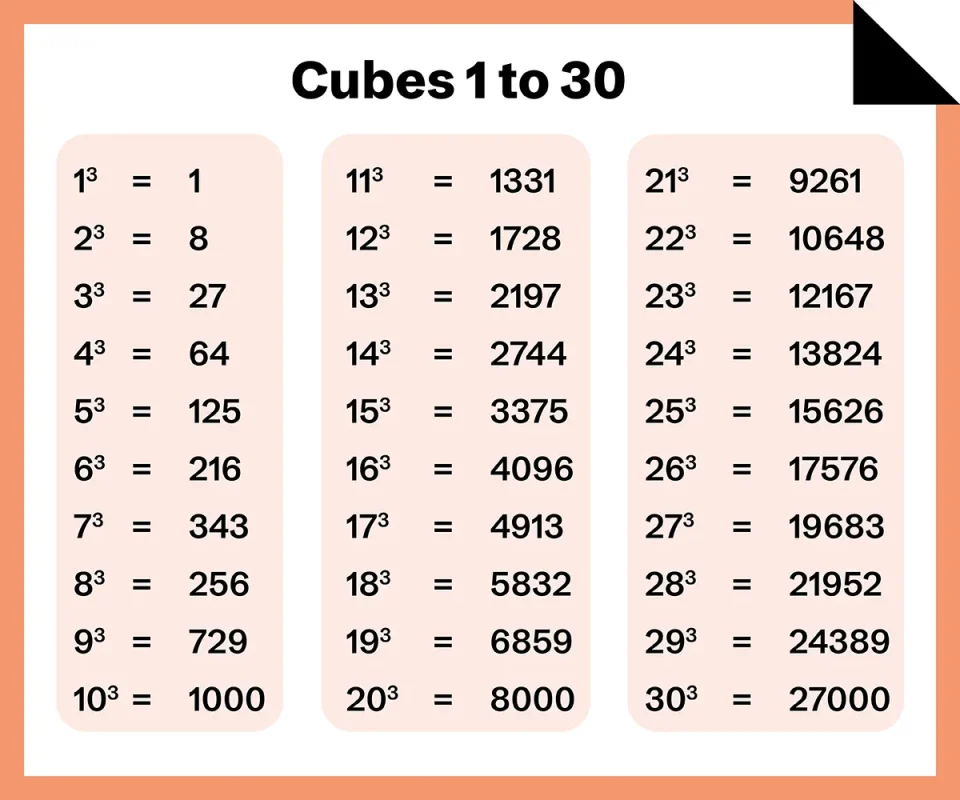
Unlike square numbers, the cubes of 1 to 30 can be a bit trickier to memorise. That’s why it’s a great idea to have a printed copy or jot them down in your math notebook. Most importantly, learning these cubes ahead of time, especially before stepping into a new class, can speed up your solving process. Thus, added below is the complete cube table 1 to 30 to help you get started:
| 13 = 1 | 163 = 4096 |
| 23 = 8 | 173 = 4913 |
| 33 = 27 | 183 = 5832 |
| 43 = 64 | 193 = 6859 |
| 53 = 125 | 203 = 8000 |
| 63 = 216 | 213 = 9261 |
| 73 = 343 | 223 = 10648 |
| 83 = 256 | 233 = 12167 |
| 93 = 729 | 243 = 13824 |
| 103 = 1000 | 253 = 15626 |
| 113 = 1331 | 263 = 17576 |
| 123 = 1728 | 273 = 19683 |
| 133 = 2197 | 283 = 21952 |
| 143 = 2744 | 293 = 24389 |
| 153 = 3375 | 303 = 27000 |
Also Learn: Animals Name in English for Kids
Cubes Chart 1 to 30
Also Learn: 50+ Colours Name in English & Hindi
Cubes from 1 to 30 – Even Numbers
In the first few days, you might end up getting mixed between every cube value. So, an easy way to memorise the cubes 1 to 30 is to start with even numbers. So, even numbers from 1 to 30 are 2, 4, 6, 8, 10, 12, 14, 16, 18, 20, 22, 24, 26, 28, and 30. To make memorisation easier, we have prepared an even cube chart 1 to 30 below:
| 23 = 8 |
| 43 = 64 |
| 63 = 216 |
| 83 = 256 |
| 103 = 1000 |
| 123 = 1728 |
| 143 = 2744 |
| 163 = 4096 |
| 183 = 5832 |
| 203 = 8000 |
| 223 = 10648 |
| 243 = 13824 |
| 263 = 17576 |
| 283 = 21952 |
| 303 = 27000 |
Also Learn: Fruits Name in English for Kids
Cubes from 1 to 30 – Odd Numbers
After learning the even cubes 1 to 30, you will feel confident. You can then start with the odd number cubes. So, the odd numbers from 1 to 30 are 1, 3, 5, 7, 9, 11, 13, 15, 17, 19, 21, 23, 25, 27, and 29. To make memorisation easier, we have prepared an odd table of cube 1 to 30 below:
| 13 = 1 |
| 33 =27 |
| 53 = 125 |
| 73 = 343 |
| 93 = 729 |
| 113 = 1331 |
| 133 = 2197 |
| 153 = 3375 |
| 173 = 4913 |
| 193 = 6859 |
| 213 = 9261 |
| 233 = 12167 |
| 253 = 15625 |
| 273 = 19683 |
| 293 = 24389 |
Also Learn: Vegetable Names in English & Hindi for Kids
How to Calculate Values of Cubes 1 to 30?
Calculating cubes 1 to 30 can be done using various methods, which can help you choose the best approach based on your preference and the complexity of the problem. Here are two common methods:
1. Direct multiplication method
The most straightforward way to calculate the cube of a number is by multiplying the number by itself three times. The cube of a number n is denoted by n3, and it’s simply:
n3 = n×n×n
For example, to calculate 43:
43 = 4×4×4 = 64
Similarly, for 73:
73 = 7×7×7 = 343
This method is easy to understand but can be time-consuming when dealing with larger numbers, especially for every cube value above 10.
2. Using cube identities
For numbers with a specific structure, such as numbers that are one less or one more than a multiple of 10 (like 9, 11, 19, etc.), you can use cube identities to simplify calculations. One such identity is the binomial expansion formula for cubes:
(a+b)3 = a3+3a2b+3ab2+b3
For instance, to calculate 113:
113 = (10+1)3 = 103+3(102)(1)+3(10)(12)+13 = 1000+300+30+1 = 1331
Moreover, this method also saves time when calculating cubes of numbers close to multiples of 10.
Also Learn: Squares 1 to 30
Tricks to Remember Cubes from 1 to 30
Finding it difficult to memorise cubes 1 to 30 all at once? Well, we’ve got you covered. Here are a few tips to help you easily learn the values of cubes so you can ace every exam:
- Start with the Basic Cubes (1 to 10): The cubes of the first ten numbers form an easy-to-remember pattern:
1³ = 1
2³ = 8
3³ = 27
4³ = 64
5³ = 125
6³ = 216
7³ = 343
8³ = 512
9³ = 729
10³ = 1000
- Break the table into smaller chunks: Once you have completed the first 10 cubes, memorise the next 10 cubes (10-20) and similarly go for 20-30. If you use this approach, you will not mix up between the value of cubes from 1 to 30.
- Use the last digit trick for cubes: Each cube’s last digit follows a pattern which is as follows:
1 → 1
2 → 8
3 → 7
4 → 4
5 → 5
6 → 6
7 → 3
8 → 2
9 → 9
10 → 0
So, remember this trick and write down the cube table from 1 to 30 in case you notice a lot of equations based on it. However, use this only if you feel you are not confident about your memorisation.
- Practice with cube tables: Print a cube table from 1 to 30 and place it somewhere visible. This is because regular exposure helps with long-term retention. The more you solve sums containing cubes, the better you will remember their values.
Thus, by using these tricks, you can easily recall and apply cube 1 to 30 during all your exams!
Solved Examples on Cubes of 1 to 30
Below are a few examples that require you to use the values of cubes 1 to 30.
Example 1: A cubical pit in a garden with a side of 12 meters is to be filled with cube-shaped soil bricks, each having a side of 2 meters. How many such bricks are needed to fill the entire pit?
Solution: Volume of pit = 123 = 1,728 m3
Volume of one brick = 23 = 8 m3
Bricks needed = 1,728 ÷ 8 = 216
Thus, 216 bricks are needed to fill the entire pit.
Example 2: A student is asked to simplify the expression:
(a+b)3−(a3+b3)
Given that a = 5 and b = 2, solve the expression.
Solution: Use identity: (a+b)3 = a3+b3+3ab(a+b)
So, the expression becomes:
(a3+b3+3ab(a+b))−(a3+b3) = 3ab(a+b)
Substitute: 3×5×2×7 = 210
Example 3: A company manufactures cube-shaped boxes with sides of 8 cm. Each box needs to be painted on all 6 sides. One can of paint covers 1,000 cm².
How many boxes can be painted with 5 cans?
Solution: Surface area of one box = 6×82 = 6×64 = 384 cm2
Total paint coverage = 5×1000 = 5000 cm2
Boxes that can be painted = 5000÷384 ≈ 13
Thus, 13 boxes can be painted with 5 cans.
Example 4: A metal cube on the side of 18 cm is melted and recast into smaller cubes on the side of 3 cm. These smaller cubes are then painted and sold. If painting costs ₹2 per cm², what is the total cost of painting all small cubes?
Solution: Volume of large cube = 183 = 5832 cm3
Volume of small cube = 33 = 27 cm3
Number of small cubes = 5832÷27 = 216
Surface area of one small cube = 6×32 = 54 cm2
Total surface area = 216×54 = 11,664 cm2
Painting cost = 11,664×2 = ₹23,328
Thus, the total cost of painting all small cubes = ₹23,328
Conclusion
Cubes are definitely a bit trickier to learn than squares. But with regular practice and consistent memorisation, you’ll be able to recall the value of cubes 1 to 30 and apply them directly in equations without second-guessing. Many students overlook the importance of learning cubes, and as a result, they end up wasting valuable time during board exams or competitive tests. But you can stay ahead of the curve! Simply print out all cubes from 1 to 30, stick it somewhere visible, and start practicing regularly. A few minutes a day can make a huge difference!
FAQs on Cubes 1 to 30
Are cubes 1 to 30 harder to remember than squares?
Yes, cube values from 1 to 30 increase faster and are generally larger, making them more difficult to memorise. However, you can easily use the tips and tricks stated above to learn them.
Are cube value always positive?
No, cubes of negative numbers can also be negative. For example, (-3)³ = -27. This is because multiplying a negative number three times retains the negative sign.
Should I memorise any cube value beyond 30?
For most school-level exams like ICSE and CBSE, the values of cubes 1 to 30 are enough. However, for higher-level competitive exams, up to 50 may be sufficient.


