

How to Use Question Banks for Class 10 Half Yearly Exam
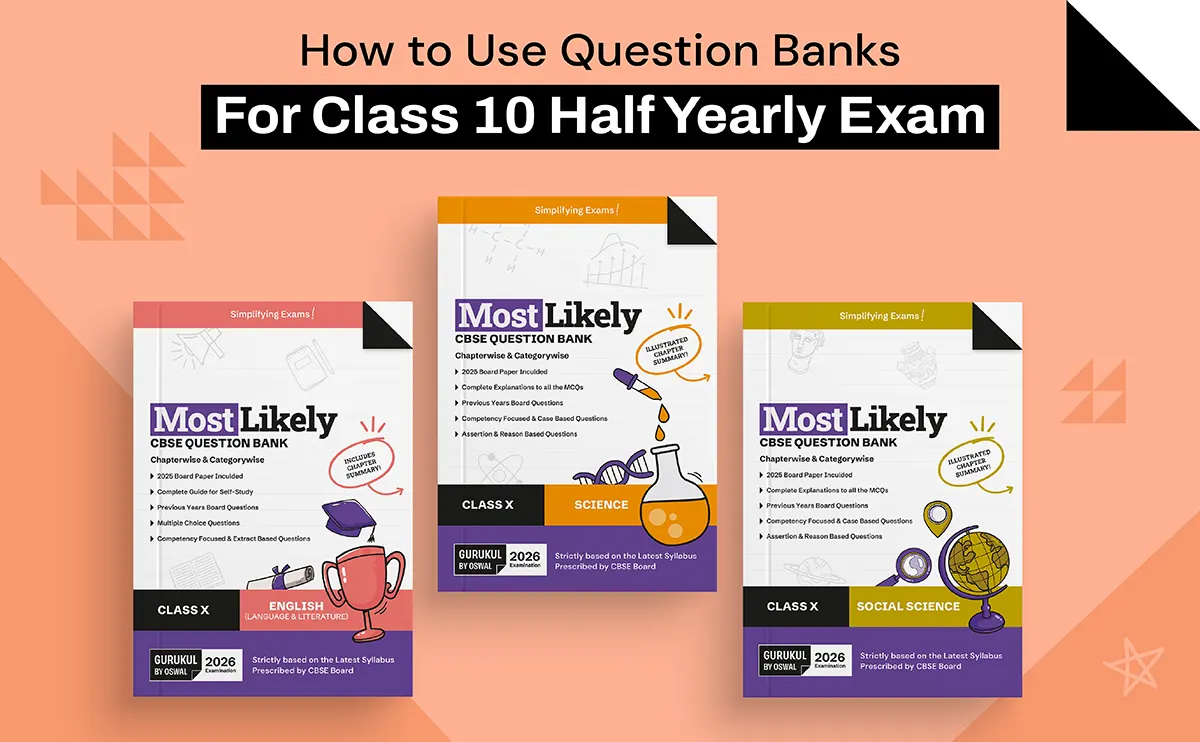
Half yearly exams are an important part of your Class 10 preparation. They test your understanding of the first half of the syllabus and show which topics need more practice before the board exams.
A Question Bank for Class 10 Half Yearly Exams helps you prepare in a structured way. It includes chapter-wise practice questions that strengthen concepts, improve answer writing, and help you understand the exam pattern and question types.
Using a well-structured Class 10 Half Yearly Question Bank regularly makes your revision more focused and organised. It helps you practise important questions, identify weak areas, improve time management, and build confidence before the exam. In this blog, you will learn how to use a Question Bank effectively to prepare smarter for your Class 10 half yearly exams.
Why Use Class 10 Question Banks for Half Yearly Exams?
Understanding the specific advantages of question banks will help you make the most of these valuable study resources during your preparation.
• Comprehensive syllabus coverage: Question Bank for Class 10 Half Yearly Exams are treasure troves of carefully selected questions that cover your entire syllabus comprehensively. They contain questions from previous years’ papers, sample papers, and expert-designed problems that match the latest exam patterns. The CBSE Class 10 Question Bank for Half Yearly Exam specifically follows the board’s latest guidelines and marking schemes.
• Improved time management skills: When you practice with a Question Bank for Class 10 Half Yearly Exams, you develop better time management skills. You learn to identify which questions to attempt first and how much time to spend on each section. Benefits of Using Question Banks Class 10 also include helping you understand the marking scheme better, as many include detailed solutions and marking guidelines.
• Pattern recognition and strategic focus: Another significant advantage is that a Question Bank for Class 10 Half Yearly Exams highlights important topics and frequently asked questions. By solving multiple question banks, you start noticing patterns in what examiners typically ask. Practice Questions for Class 10 Half Yearly Exams expose you to various question types and formats, helping you prioritise your revision.
• Confidence building and immediate feedback: A Question Bank for Class 10 Half Yearly Exams also builds your confidence gradually. Starting with easier questions and progressing to challenging ones helps you overcome exam anxiety. Additionally, these resources provide instant feedback through their answer keys, helping you identify and correct mistakes immediately rather than carrying forward misconceptions.
How to Use Class 10 Question Banks Effectively
Now that you know why you should use question bank, let us understand how exactly to use them effectively:
Start with Syllabus Analysis
Begin by thoroughly examining your half yearly exam syllabus. Create a checklist of all topics that will be covered in the exam. Match this with your Question Bank for Class 10 Half Yearly Exams contents to ensure you’re practising relevant material. Mark the weightage of each topic according to your school’s exam pattern. This helps you allocate study time proportionally to each subject area.
Create a Study Schedule

Design a realistic timetable that incorporates Question Bank for Class 10 Half Yearly Exams practice into your daily routine. Dedicate specific time slots for solving questions from different subjects. For example, you might solve Maths questions in the morning when your mind is fresh and Science questions in the evening. Ensure you leave buffer time for revision and doubt clearing. Class 10 Exam Preparation Tips with Question Banks suggest allocating at least 2-3 hours daily for question bank practice.
Subject-wise Approach
For Mathematics: Start with formula-based questions before moving to word problems. Practice different types of questions from each chapter systematically. Focus on step-by-step solutions to understand the methodology.
For Science: Begin with definition-based questions, then move to diagram-based and numerical problems. Pay special attention to practical-based questions as they often appear in exams.
For Social Science: Practice map work, case studies, and source-based questions regularly. Focus on understanding concepts rather than memorising answers.
For Languages: Work on grammar exercises, comprehension passages, and writing formats systematically.
Progressive Difficulty Levels
Always start with basic level questions to build confidence. Once comfortable, gradually move to moderate and then challenging questions. This step-by-step approach prevents frustration and maintains motivation. Keep separate notebooks for different difficulty levels to track your progress effectively.
Time-bound Practice
Set specific time limits for solving question bank exercises. This simulates real exam conditions and improves your speed. Initially, focus on accuracy over speed, then gradually work on reducing time taken whilst maintaining correctness. Use a timer during practice sessions to develop better time awareness.
Regular Review and Analysis
After completing each Question Bank for Class 10 Half Yearly Exams session, spend time analysing your performance. Identify topics where you made mistakes and revisit those concepts. Create a separate error log to track recurring mistakes. This systematic review process is crucial for continuous improvement and prevents repetition of the same errors. Choose from the Best Question Banks for Class 10 available at Oswal Publishers to ensure quality practice material.
Also Read: Common Mistakes to Avoid While Preparing with CBSE Class 10 Question Banks
Tips to Score 90+ in Class 10 Half Yearly Exams
Achieving exceptional marks requires strategic planning and smart study techniques that go beyond regular preparation methods.
• Master the art of selective studying: Focus 70% of your time on high-weightage topics and 30% on remaining portions. Question banks help identify these crucial areas through repeated question patterns.
• Develop a three-round revision strategy: First round for understanding concepts, second round for solving question banks, and third round for quick revision using your notes and error logs.
• Perfect your presentation skills: Practice writing neat, well-structured answers. Use proper headings, bullet points, and diagrams where required. Good presentation can earn you extra marks even with average content.
• Create summary sheets: After solving a Question Bank for Class 10 Half Yearly Exams, prepare one-page summaries for each chapter containing key formulas, important dates, and crucial concepts for quick last-minute revision.
• Practice previous years’ papers: Combine question bank practice with solving actual previous years’ half yearly papers to understand the exact exam format and difficulty level your school follows.
Common Mistakes to Avoid
Understanding and avoiding these frequent errors can save you valuable marks and improve your overall exam performance significantly.
• Avoid random topic jumping: Many students make the mistake of randomly jumping between topics without completing one thoroughly. This creates confusion and incomplete understanding. Instead, finish all questions from one chapter in your Question Bank for Class 10 Half Yearly Exams before moving to the next.
• Don’t ignore basic questions: Another common error is focusing only on difficult questions while ignoring basic ones. Remember, easy questions carry the same marks and are scoring opportunities you cannot afford to miss.
• Never skip answer-checking: Students often skip the answer-checking process, missing valuable learning opportunities. Always compare your answers with the provided solutions, even when you think you’re correct.
• Practice with time limits: Many make the mistake of practicing without time limits, which leads to poor time management during actual exams. Always set timers during practice sessions.
• Understand, don’t memorise: Avoid the temptation to memorise answers from your Question Bank for Class 10 Half Yearly Exams instead of understanding the underlying concepts. This approach fails when questions are twisted or presented differently in exams.
Also Check: CBSE Class 10 Toughest and Easiest Chapters (All Subjects)
Conclusion
A Question Bank for Class 10 Half Yearly Exams is a powerful tool that can significantly boost your half yearly exam performance when used strategically. They provide structured practice, expose you to various question formats, and help build the confidence needed for excellent results.
The key lies in consistent, systematic practice combined with regular analysis of your performance. Remember that a Question Bank for Class 10 Half Yearly Exams is most effective when used alongside your textbooks and class notes, not as replacements for them.
Make question bank practice a daily habit, stay consistent with your schedule, and maintain a positive attitude towards learning. With dedicated effort and smart preparation using quality question banks, achieving outstanding results in your Class 10 half yearly exams is entirely within your reach. Success awaits those who prepare systematically!
FAQs
How many question banks should I solve for each subject?
Aim for 2-3 quality question banks per subject. Focus on solving them thoroughly rather than attempting many superficially.
When should I start using question banks for half yearly preparation?
Begin question bank practice at least 6-8 weeks before your exams, after completing your basic syllabus reading.
Should I solve question banks chapter-wise or mix different topics?
Start chapter-wise to build strong foundations, then practice mixed topic papers closer to exam dates for comprehensive revision.
What if I can’t solve most questions in a question bank?
Don’t worry! Start with easier question banks and gradually progress. Focus on understanding solutions rather than just getting answers right initially.
