



Is CUET Tough or Easy? Exam Difficulty Level & Preparation Tips


The Common University Entrance Test (CUET) is a national-level entrance exam designed for students seeking admission to undergraduate (UG) and postgraduate (PG) programmes in central, state, and private universities across India. The primary concern for many students is: “Is CUET tough or easy?” The CUET exam toughness depends on multiple factors, including a student’s familiarity with the syllabus, conceptual clarity, time management skills, and overall preparation strategy.
For some, is CUET tough or easy can be answered based on their academic strengths. Since it aligns with the NCERT syllabus at the UG level, it may seem manageable for some students, while for others, especially PG aspirants, it can be more challenging due to in-depth subject-specific questions. The key to cracking CUET entrance exam difficulty lies in structured preparation, understanding the exam pattern, and practising regularly. Students can significantly improve their performance and boost confidence with the right approach and study materials, like Oswal Publishers’ CUET Books.
Continue reading to get a detailed answer on how hard is CUET.
Is CUET Tough or Easy?
The CUET exam is a crucial gateway for students aspiring to secure admission in various undergraduate and postgraduate programmes across India. Many students wonder whether is CUET tough or easy, and the answer depends on multiple factors such as the student’s academic background, preparation strategy, and familiarity with the exam format. Here are the detailed reasons why “is CUET exam tough?”
Factors Influencing Difficulty Level
The CUET exam complexity varies based on several factors:
- Syllabus Coverage: Since is CUET tough or easy depends on preparation, it could be different for UG and PG students. This is because CUET UG is based on the NCERT syllabus, while CUET PG includes subject-specific questions, making it relatively more challenging.
- Exam Format: Being an MCQ-based exam, CUET requires a strong conceptual understanding rather than rote learning.
- Time Management: The large number of questions within a limited time can be overwhelming, but with practice, students can manage effectively.
- Competitiveness: With lakhs of students appearing for CUET, the competition is high, making preparation crucial for success, further affecting how students perceive is CUET tough or easy.
- Subject-Specific Variations: Science and Mathematics tend to be tougher due to complex numerical problems, while theoretical subjects require strong analytical skills.
- Difficulty Variation Among Universities: Some universities have higher cutoffs, making competition tougher.
Section-wise Difficulty Analysis
Each section in CUET presents its challenges based on the type of questions asked and the skills required. A strategic approach to each section can significantly enhance performance.
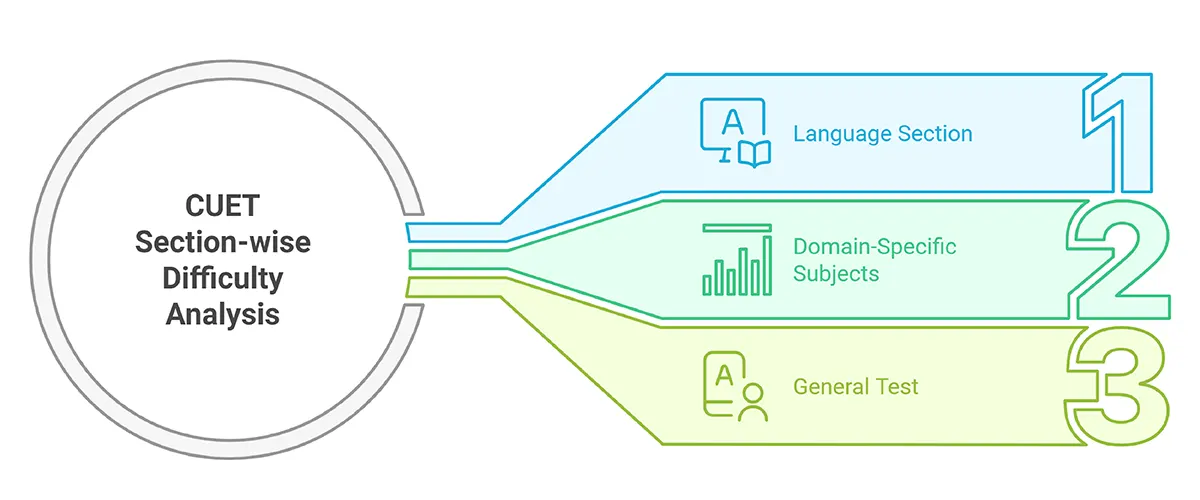
- Language Section: Moderate difficulty with reading comprehension, vocabulary, and grammar-based questions. Proficiency in English or Hindi plays a vital role.
- Domain-Specific Subjects: The difficulty level depends on the subject. Subjects like Mathematics and Science can be trickier due to numerical problems, whereas Humanities subjects may focus on analytical and theoretical concepts.
- General Test: Logical reasoning, quantitative aptitude, and general knowledge questions can be easy for well-prepared students. However, the difficulty varies based on preparation levels and prior exposure.
Comparison with Other Entrance Exams
Many students ask, is CUET tough or easy compared to other competitive exams? CUET exam difficulty differs from other entrance exams in terms of syllabus coverage, and question pattern. Understanding these differences can help candidates prepare more effectively.
- Easier than JEE & NEET: Unlike JEE or NEET, CUET does not have subjective or high-level numerical questions, making it relatively easier and helping students determine is CUET tough or easy.
- Similar to Board Exams: Since CUET UG follows the NCERT syllabus, it is aligned with Class 12 studies, making it manageable for students.
- Challenging for PG Aspirants: CUET PG includes a broader range of subjects and requires in-depth knowledge of core concepts.
- Varies by Stream: Science students may find it easier due to familiarity with MCQ-based questions, while Commerce and Humanities students may need to adapt to a new testing format.
Also Check: Advantages and Disadvantages of CUET 2026 Exam
Understanding CUET Exam Pattern
Students often debate is CUET tough or easy, but understanding the exam pattern helps in better preparation. Here’s how it works:
CUET UG Exam Pattern:
- Sections:
- Section IA: Language test
- Section IB: Additional language test
- Section II: Domain-specific test
- Section III: General test
- Number of questions:
- Language tests (Sections IA & IB): 50 questions each
- Domain-specific test (Section II): 50 questions
- General test (Section III): 50 questions
- Time allocation:
- Language tests: 60 minutes each
- Domain-specific test: 60 minutes
- General test: 60 minutes
- Marking scheme:
- Correct answer: +5 marks
- Incorrect answer: -1 mark
- Unattempted questions: No marks deducted
CUET PG Exam Pattern:
- Structure:
- The exam consists of 75 multiple-choice questions (MCQs) focusing entirely on domain-specific knowledge.
- Time allocation:
- 90 minutes
- Marking scheme:
- Correct answer: +4 marks
- Incorrect answer: -1 mark
- Unattempted questions: No marks deducted
Recent Changes in CUET Exam Pattern
- Introduction of More Subject Choices: Candidates can now choose from a wider range of subjects in CUET UG.
- Revised Section Timings: Some sections have adjusted time limits to accommodate better time management for students.
- Inclusion of More Analytical Questions: CUET PG includes more reasoning and subject-oriented analytical questions to test deeper conceptual understanding.
Also Check: CUET Fee Structure 2026: Registration, Counselling & Other Charges
CUET 2026 Exam Preparation Tips
If you are wondering is CUET tough or easy, preparation is the key! Here are some CUET exam preparation tips to get started:
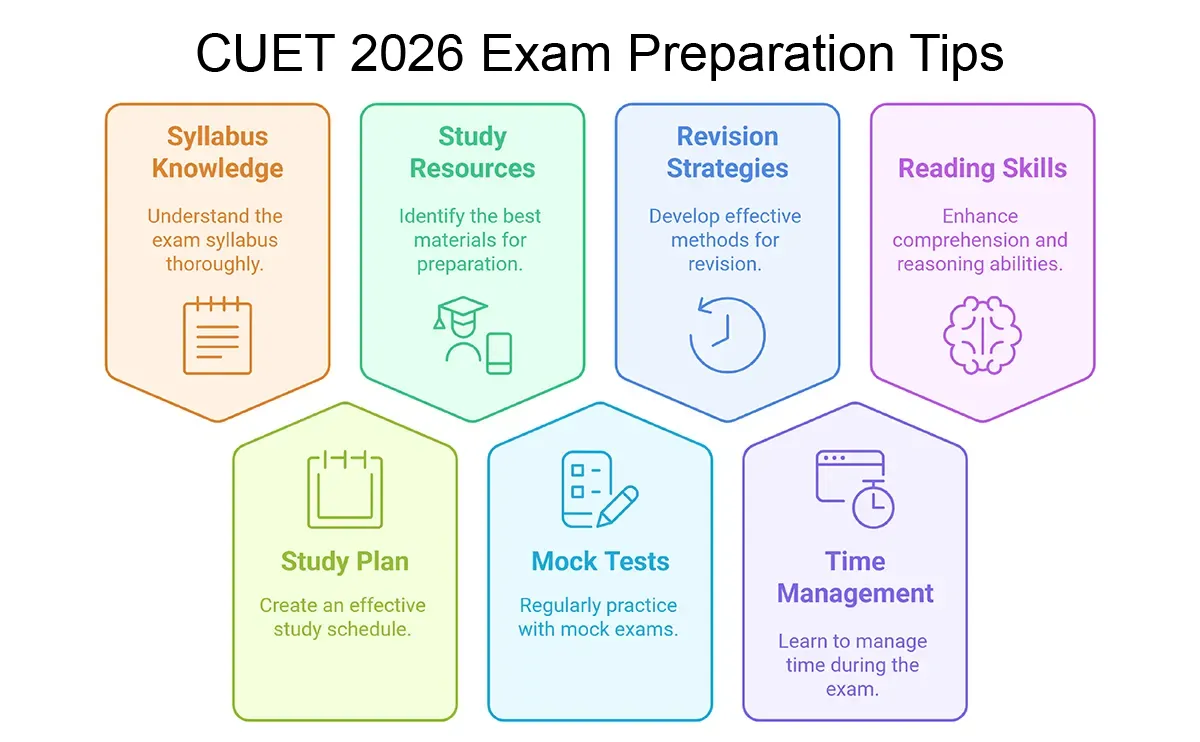
Know the Syllabus in Detail
- CUET UG syllabus follows Class 12 NCERT textbooks, so ensure complete coverage of each topic.
- CUET PG syllabus varies based on specialisation, so check the official CUET website and past question papers for subject-wise details.
- Focus on high-weightage topics and practice previous years’ question papers to understand the exam pattern.
Effective Study Plan
- Divide study time wisely for all subjects, ensuring balanced preparation.
- Allocate extra hours for difficult topics and regular revision.
- Identify weak areas early and strengthen conceptual clarity with targeted practice.
- Avoid last-minute cramming; instead, revise periodically and take short notes for quick reference.
Best study resources for CUET
- Oswal Publishers’ CUET UG & PG Books: Tailored study materials covering all important concepts.
- NCERT textbooks (for UG): The base resource for CUET UG preparation.
- Official CUET PG syllabus books for subject-specific preparation.
- CUET sample papers and mock tests available on the official website to get a real exam feel.
Practice Mock Tests
- Attempt full-length mock tests regularly to improve speed and accuracy, and find out is CUET tough or easy for you.
- Solve previous years’ CUET question papers to understand the exam pattern.
- Attempt sectional tests to focus on weak areas.
- Analyse mistakes in each test to avoid repeating errors in the final exam.
Revision Strategies
- Create short notes and mind maps for quick recall.
- Revise important formulas, definitions, and theoretical concepts daily.
- Solve previous years’ question papers under timed conditions to build confidence.
- Use flashcards and memory techniques to retain key facts efficiently.
Also Check: CUET Marks vs Percentile 2026: Full Guide
Time Management During the Exam
- Divide time smartly between different sections; don’t get stuck on one question.
- Attempt easier questions first to build confidence.
- Keep the last 10-15 minutes for revising answers and correcting mistakes.
- For PG exams: If there’s a subjective section, frame answers clearly with headings and points.
Improve Reading Comprehension & Logical Reasoning
- Practice reading comprehension passages daily for CUET UG & PG English sections to improve speed.
- Solve puzzles, syllogisms, and logical reasoning questions regularly to improve analytical thinking.
- Read newspapers and articles to enhance vocabulary and stay updated on current affairs.
These CUET study strategies will help you stay on track and excel in the CUET UG and PG exams. Keep practising and revising regularly!
How to Stay Confident During CUET Preparation
Many students stress about is CUET tough or easy, but confidence plays a crucial role in achieving success. Here’s how to stay motivated:
- Follow a structured routine to maintain consistency in studies.
- Take regular breaks to avoid burnout and maintain productivity.
- Stay physically active by incorporating exercise and relaxation techniques into your daily routine.
- Join study groups or coaching to interact with peers and gain better insights.
- Stay updated with exam notifications and changes to avoid last-minute surprises.
- Develop a positive mindset by setting achievable goals and celebrating small milestones.
Conclusion
Is CUET tough or easy? The answer for the CUET admission test difficulty level depends on preparation! With the right study material, time management, and regular practice, students can crack CUET successfully. Stay focused, believe in yourself, and make use of quality resources like Oswal Publishers’ CUET Books to ace the exam. Success in CUET is not about rote learning but applying knowledge effectively under time constraints.
FAQs
Q1. Is CUET exam tough or the board exam?
Ans – CUET UG is based on the Class 12 syllabus, making boards similar to CUET difficulty level. However, time constraints, competition, and the MCQ format make CUET challenges more complex for some students.
Q2. How many attempts can I take for CUET?
Ans – Currently, CUET is conducted once a year, and candidates can appear for it multiple times in different admission cycles.
Q3. What are the best books for CUET preparation?
Ans – Oswal Publishers’ CUET books provide subject-wise preparation, previous years’ papers, and practice questions to help students succeed.
Q4. How should I manage time during CUET preparation?
Ans – Create a structured timetable, focus on high-weightage topics, and attempt timed mock tests for better time management.
Q5. Where can I find CUET study materials?
Ans – Check out Oswal Publishers’ CUET books for comprehensive study guides and practice materials.


