

Opposite Words for Class 1 Students
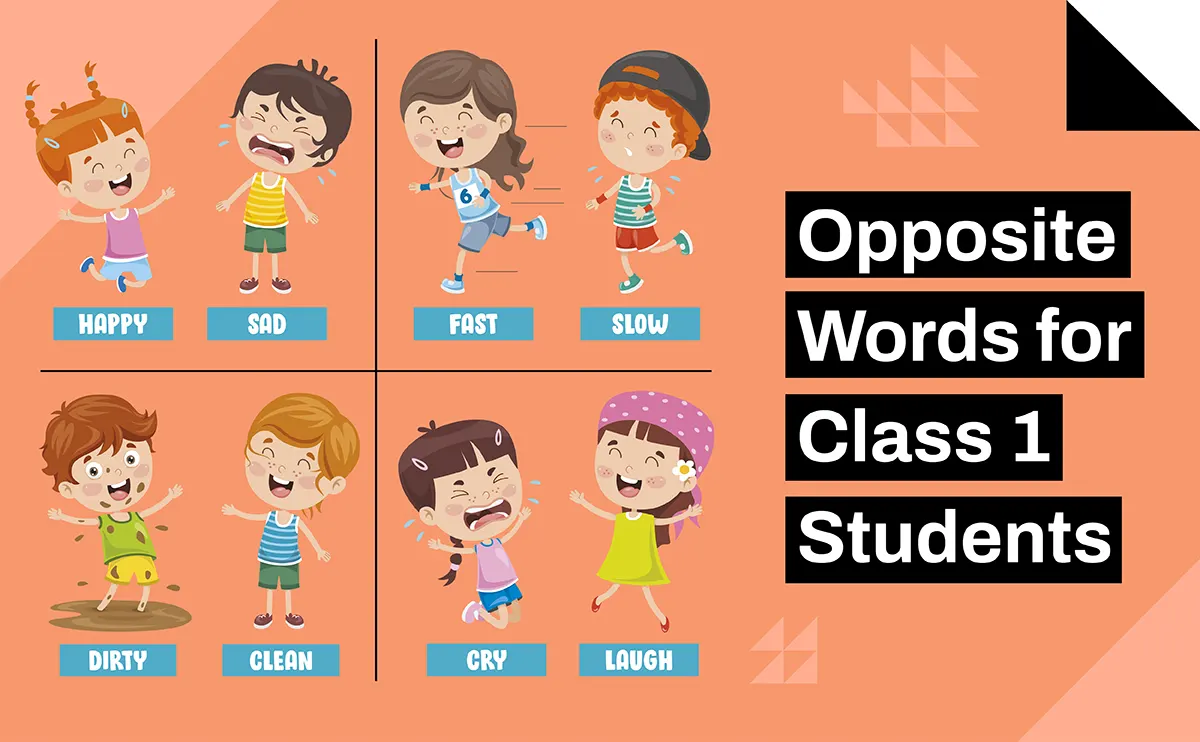
Learning opposite words for class 1, is like discovering two sides of the same coin! For young learners in Class 1, understanding opposite words helps build a strong foundation in English vocabulary. When children learn that “big” is the opposite of “small” or “happy” is the opposite of “sad,” they begin to understand how language works in pairs. This knowledge helps them express themselves better and understand the world around them more clearly. Our guide is specially designed for opposite words for class 1 students, using simple words and fun examples that make learning enjoyable.
By mastering opposite words, children develop better communication skills, improve their reading comprehension, and build confidence in using Class 1 English effectively.
- ▪ 100+ Opposite Words for Class 1 in English
- ▪ 10 Easy Opposite Words for Class 1
- ▪ 50 Opposite Words for Class 1
- ▪ A to Z Easy Opposite Words Class 1
- ▪ Some Commonly Used Opposite Words in English
- ▪ Opposite Words Related to Personality
- ▪ Benefits of Learning Opposite Words in English for Kids
- ▪ Effective Ways to Teach Children Opposite Words
- ▪ Opposite Words Exercise
- ▪ FAQs
100+ Opposite Words for Class 1 in English
Here’s a comprehensive list of opposite words perfect for young learners:
| Word | Opposite |
| Big | Small |
| Hot | Cold |
| Up | Down |
| Happy | Sad |
| Good | Bad |
| Fast | Slow |
| Light | Dark |
| Clean | Dirty |
| Old | New |
| Tall | Short |
| Fat | Thin |
| Rich | Poor |
| Full | Empty |
| Hard | Soft |
| Heavy | Light |
| Loud | Quiet |
| Open | Close |
| Right | Wrong |
| Strong | Weak |
| Sweet | Sour |
| Wet | Dry |
| Young | Old |
| Black | White |
| Day | Night |
| First | Last |
| Front | Back |
| High | Low |
| Inside | Outside |
| Left | Right |
| Long | Short |
| Near | Far |
| Over | Under |
| Push | Pull |
| Round | Square |
| Sharp | Blunt |
| Smooth | Rough |
| Thick | Thin |
| Top | Bottom |
| Warm | Cool |
| Wide | Narrow |
| Win | Lose |
| Yes | No |
| Come | Go |
| Give | Take |
| Buy | Sell |
| Find | Lose |
| Love | Hate |
| Start | Stop |
| Wake | Sleep |
| Laugh | Cry |
| Sit | Stand |
| Run | Walk |
| Jump | Fall |
| Catch | Throw |
| Build | Break |
| Enter | Exit |
| Forget | Remember |
| Begin | End |
| Include | Exclude |
| Accept | Reject |
| Appear | Disappear |
| Arrive | Depart |
| Attack | Defend |
| Borrow | Lend |
| Climb | Descend |
| Connect | Disconnect |
| Create | Destroy |
| Dance | Still |
| Develop | Decline |
| Encourage | Discourage |
| Expand | Contract |
| Export | Import |
| Fail | Succeed |
| Follow | Lead |
| Freeze | Melt |
| Gather | Scatter |
| Grow | Shrink |
| Hide | Show |
| Increase | Decrease |
| Join | Separate |
| Keep | Discard |
| Like | Dislike |
| Move | Stay |
| Obey | Disobey |
| Play | Work |
| Question | Answer |
| Rise | Fall |
| Save | Spend |
| Teach | Learn |
| Unite | Divide |
| Visit | Leave |
| Work | Rest |
| Zip | Unzip |
Also Learn: Fruits Name that Start with N
10 Easy Opposite Words for Class 1

Here are ten simple opposite words for class 1 pairs that every young student should know:
- Big – Small: An elephant is big, but a mouse is small.
- Hot – Cold: Fire is hot, but ice is cold.
- Happy – Sad: We feel happy when we play, but sad when we cry.
- Day – Night: We play during the day and sleep at night.
- Up – Down: Birds fly up in the sky, but leaves fall down.
- Fast – Slow: A cheetah runs fast, but a turtle moves slow.
- Good – Bad: Helping others is good, but hurting them is bad.
- Clean – Dirty: We wash our hands to keep them clean, not dirty.
- Full – Empty: A full glass has water, an empty glass has nothing.
- New – Old: A new toy is fresh, but an old toy has been used before.
50 Opposite Words for Class 1
Here’s an expanded list of fifty opposite words for class 1st perfect for young learners, organised by different categories:
1. Basic Opposites: Big-Small, Hot-Cold, Up-Down, Happy-Sad, Good-Bad, Fast-Slow, Light-Dark, Clean-Dirty, Old-New, Tall-Short, Fat-Thin, Rich-Poor, Full-Empty, Hard-Soft, Heavy-Light, Loud-Quiet, Open-Close, Right-Wrong, Strong-Weak, Sweet-Sour.
2. Movement and Direction: Come-Go, Push-Pull, Jump-Fall, Run-Walk, Climb-Descend, Enter-Exit, Rise-Fall, Move-Stay, Follow-Lead, Dance-Still.
3. Descriptive Words: Wet-Dry, Young-Old, Black-White, First-Last, Front-Back, High-Low, Inside-Outside, Left-Right, Long-Short, Near-Far.
4. Action Words: Give-Take, Buy-Sell, Find-Lose, Love-Hate, Start-Stop, Wake-Sleep, Laugh-Cry, Sit-Stand, Catch-Throw, Build-Break.
Also Learn: Water Animals Name in English and Hindi
A to Z Easy Opposite Words Class 1
Here’s a fun alphabetical journey through opposite words a to z, with simple examples for each letter:
A: Above-Below, All-None, Always-Never, Awake-Asleep
B: Beautiful-Ugly, Begin-End, Big-Small, Black-White
C: Clean-Dirty, Come-Go, Cool-Warm, Cry-Laugh
D: Day-Night, Deep-Shallow, Dirty-Clean, Down-Up
E: Early-Late, Easy-Hard, Empty-Full, Enter-Exit
F: Fast-Slow, Fat-Thin, First-Last, Full-Empty
G: Give-Take, Good-Bad, Go-Come, Grow-Shrink
H: Happy-Sad, Hard-Soft, Heavy-Light, Hot-Cold
I: In-Out, Inside-Outside, Increase-Decrease, Include-Exclude
J: Jump-Fall, Join-Separate, Just-Unjust, Joy-Sorrow
K: Keep-Discard, Kind-Cruel, Know-Unknown, Kick-Catch
L: Large-Small, Light-Dark, Love-Hate, Loud-Quiet
M: More-Less, Many-Few, Morning-Evening, Move-Stay
N: New-Old, Near-Far, Nice-Nasty, North-South
O: Open-Close, Old-New, Over-Under, Outside-Inside
P: Push-Pull, Pretty-Ugly, Present-Absent, Peace-War
Q: Quick-Slow, Quiet-Loud, Question-Answer, Queen-King
R: Right-Wrong, Rich-Poor, Run-Walk, Round-Square
S: Strong-Weak, Sweet-Sour, Sit-Stand, Small-Big
T: Tall-Short, Thick-Thin, Top-Bottom, Take-Give
U: Up-Down, Under-Over, Unite-Divide, Ugly-Beautiful
V: Victory-Defeat, Visible-Invisible, Vertical-Horizontal, Visit-Leave
W: Win-Lose, Wet-Dry, White-Black, Wide-Narrow
X: Extra-Less, X-ray-Normal, Xerox-Original, Xmas-Ordinary
Y: Yes-No, Young-Old, Yesterday-Tomorrow, Yell-Whisper
Z: Zero-Many, Zip-Unzip, Zoom-Slow, Zone-Everywhere
Also Learn: Tongue Twisters in English For Kids
Some Commonly Used Opposite Words in English
Opposite Word for Clean
Clean – Dirty: Clean means something is free from dirt, dust, or marks. For example, “Mum keeps our house clean by sweeping and mopping every day.” The opposite is dirty, which means something has dirt or stains on it. “My shoes became dirty after playing in the mud.” These opposite words in english help children describe the world around them.
Opposite Word for Little
Little – Big: Little means something is small in size or amount. “The little puppy fits in my hands.” The opposite is big, which means something is large in size. “The big elephant is much bigger than the little puppy.” Learning such basic opposite word in english is essential for vocabulary building.
Opposite Word for Heavy
Heavy – Light: Heavy means something weighs a lot and is difficult to lift. “The heavy box requires two people to carry it.” The opposite is light, which means something weighs very little. “The light feather floats in the air.” These opposite words are commonly used in daily conversations.
Opposite Word for Narrow
Narrow – Wide: Narrow means something is not wide, with little space from side to side. “The narrow path allows only one person to walk.” The opposite is wide, which means having a lot of space from side to side. “The wide road allows many cars to drive together.”
Opposite Words Related to Personality
Understanding personality opposites helps children describe people better. Here are common personality opposite words for class 1 that teach about different character traits:
- Kind – Cruel: Being nice versus being mean
- Brave – Scared: Being fearless versus being afraid
- Honest – Dishonest: Telling the truth versus lying
- Polite – Rude: Having good manners versus bad manners
- Generous – Selfish: Sharing with others versus keeping everything for yourself
- Patient – Impatient: Waiting calmly versus getting upset quickly
- Friendly – Unfriendly: Being nice to others versus being mean
- Careful – Careless: Being cautious versus being reckless
- Cheerful – Gloomy: Being happy versus being sad
- Confident – Shy: Being sure of yourself versus being nervous around others
Benefits of Learning Opposite Words in English for Kids
Learning opposite words for class 1 provides numerous benefits for young students:
- Vocabulary Development: Doubles the number of words children know with each opposite pair learned.
- Reading Comprehension: Helps children better understand story contexts and character descriptions.
- Critical Thinking: Develops skills by teaching children to compare and contrast different concepts.
- Communication Skills: Children can express themselves more precisely using appropriate opposite words for kids.
- Language Confidence: Builds confidence in language use, making children more comfortable with English conversations and writing activities.
Effective Ways to Teach Children Opposite Words
Teaching opposite words for class 1 can be fun and engaging with these proven methods:
- Visual learning: Use colourful picture cards showing opposite concepts like hot/cold images, big/small objects, or happy/sad faces. Children learn better when they can see the difference between concepts visually.
- Action Games: Play interactive games like “Simon Says” using opposite actions such as sit/stand, jump/crawl, or clap/stop. Physical movement helps children remember opposite words through body memory.
- Story Time: Read engaging books that emphasise antonyms for kids in context. Choose stories where characters experience different emotions or encounter various situations that naturally showcase opposite words.
- Daily Activities: Point out opposites during everyday routines like “The milk is cold, but the soup is hot” or “Your room is messy, let’s make it clean.” This makes learning practical and relevant.
- Songs and Rhymes: Create catchy songs or use nursery rhymes that include opposite words. Musical patterns help children remember vocabulary more easily and make learning enjoyable.
- Matching Games: Design simple games where children match picture cards or word cards with their opposites. Use colourful materials and reward correct matches to keep children motivated.
Opposite Words Exercise
Multiple Choice Questions for Class 1 Students:
- What is the opposite of “big”?
a) Large b) Small c) Huge d) Tall - The opposite of “hot” is:
a) Warm b) Cool c) Cold d) Boiling - What is the opposite of “happy”?
a) Joyful b) Sad c) Excited d) Cheerful - The opposite of “up” is:
a) High b) Top c) Down d) Above - What is the opposite of “fast”?
a) Quick b) Slow c) Rapid d) Swift - The opposite of “clean” is:
a) Neat b) Tidy c) Dirty d) Fresh - What is the opposite of “day”?
a) Morning b) Evening c) Night d) Afternoon - The opposite of “full” is:
a) Complete b) Empty c) Packed d) Loaded - What is the opposite of “good”?
a) Great b) Bad c) Nice d) Fine - The opposite of “new” is:
a) Fresh b) Modern c) Old d) Recent
Answers: 1-b, 2-c, 3-b, 4-c, 5-b, 6-c, 7-c, 8-b, 9-b, 10-c
FAQs
At what age should children start learning opposite words?
Children can start learning basic opposite words as early as 2-3 years old, with formal learning beginning in Class 1 (ages 5-6).
How many opposite words should a Class 1 student know?
A Class 1 student should comfortably know 20-30 basic opposite word pairs, gradually building to 50+ pairs throughout the year.
What’s the best way to help my child remember opposite words?
Use visual aids, daily conversations, games, and consistent practice. Relating opposites to real-life situations helps children remember them better.
Are there any apps or online resources for teaching opposite words?
Yes, many educational apps and websites offer interactive games and activities specifically designed for teaching opposite words to young children.
