

Squares 1 to 30: Values, Table, Chart & Tricks to Remember
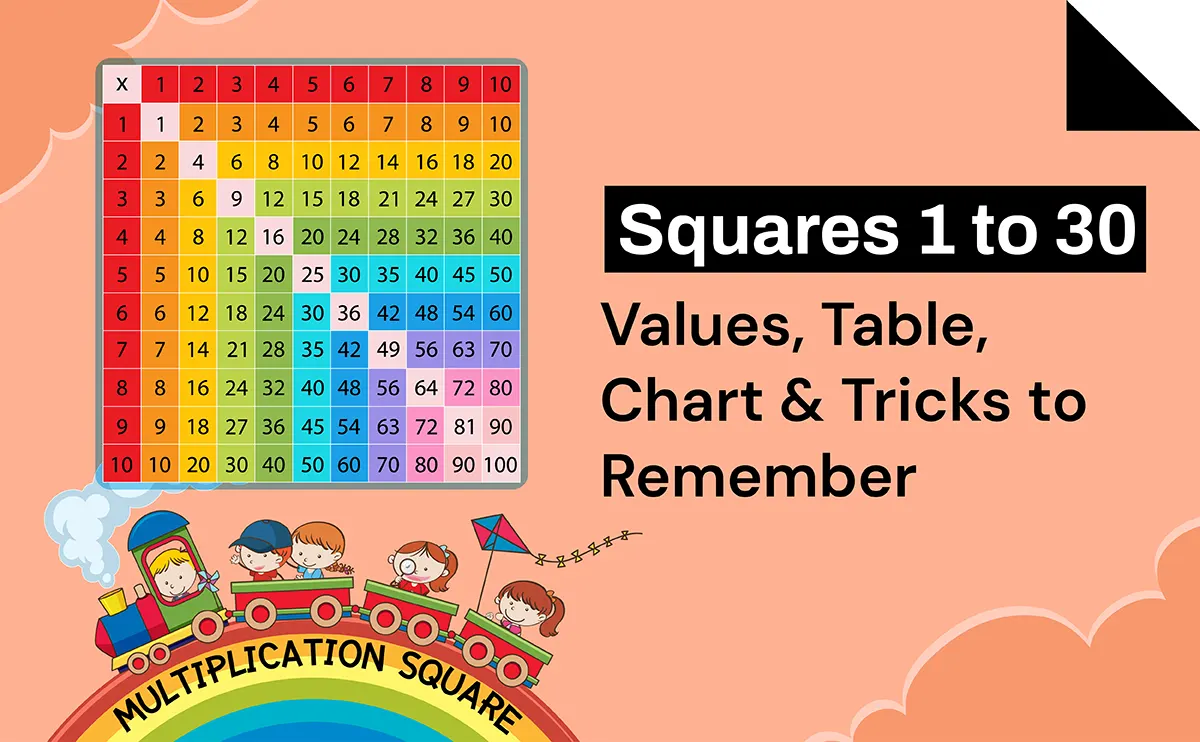
You must’ve heard your Maths teacher use the term square numbers. If not, it’s time you know what they are so you can stay ahead of your classmates. So, a square number is the result of multiplying a number by itself, such as 9 (3 x 3) or 16 (4 x 4). They are used in various areas, like algebraic equations, geometry, and basic calculations. So, if you have learnt square 1 to 30, it will be enough to solve the majority of sums in CBSE and ICSE boards as you can apply what you learnt without the need to multiply the square of each number manually. Thus, this blog will cover the squares from 1 to 30 and also share easy tips and tricks to learn them with ease.
- ▪ Squares 1 to 30
- ▪ List of All Squares from 1 to 30
- ▪ Squares Chart 1 to 30
- ▪ Square Root 1 to 30
- ▪ Square Root 1 to 30 even numbers
- ▪ Squares from 1 to 30 - Odd Numbers
- ▪ How to Calculate Values of Squares 1 to 30?
- ▪ Tricks to Remember Squares from 1 to 30
- ▪ Solved Examples on Squares of 1 to 30
- ▪ Conclusion
- ▪ FAQs
Squares 1 to 30
The square values from 1 to 30 are the results of multiplying each number by itself, such as 1², 2², 3², and so on up to 30². As discussed earlier, memorising the square 1 to 30 values can help you solve equations quickly. The square numbers from 1 to 30 in exponential form are as follows:
- Exponent Form = x²
- Lowest Value = (1)² = 1
- Highest Value = (30)² = 900
Therefore, the range of squares from 1 to 30 is 1 – 900.
Must Buy: Children Books
List of All Squares from 1 to 30
To memorise and apply the squares 1 to 30 easily, you can print out the table below that lists each square value. Revising this table with each square 1 to 30 for 3 to 4 days will make you fluent in recalling these squares, much like how you got comfortable with the multiplication tables of individual numbers.
| 12 = 1 | 162 = 256 |
| 22 = 4 | 172 = 289 |
| 32 = 9 | 182 = 324 |
| 42 = 16 | 192 = 361 |
| 52 = 25 | 202 = 400 |
| 62= 36 | 212 = 441 |
| 72 = 49 | 222 = 484 |
| 82 = 64 | 232 = 529 |
| 92 = 81 | 242 = 576 |
| 102 = 100 | 252 = 625 |
| 112 = 121 | 262 = 676 |
| 122 = 144 | 272 = 729 |
| 132 = 169 | 282 = 784 |
| 142 = 196 | 292 = 841 |
| 152 = 225 | 302 = 900 |
Also Learn: Animals Name in English for Kids
Squares Chart 1 to 30

Square Root 1 to 30
Now that you’re familiar with the values of square 1 to 30, there is another concept called square root. It’s the value that gives the original number when multiplied by itself. For example, the square root of 16 is 4 because 4 multiplied by itself gives you 16. So, just like square numbers, you will also need to memorise square root values. However, you only need to memorise the values of square root 1 to 30. That’s why below is a square root table 1 to 30 for easy reference:
| √1 = 1 | √11 ≈ 3.32 | √21 ≈ 4.58 |
| √2 ≈ 1.41 | √12 ≈ 3.46 | √22 ≈ 4.69 |
| √3 ≈ 1.73 | √13 ≈ 3.61 | √23 ≈ 4.79 |
| √4 = 2 | √14 ≈ 3.74 | √24 ≈ 4.89 |
| √5 ≈ 2.24 | √15 ≈ 3.87 | √25 = 5 |
| √6 ≈ 2.45 | √16 = 4 | √26 ≈ 5.10 |
| √7 ≈ 2.65 | √17 ≈ 4.12 | √27 ≈ 5.19 |
| √8 ≈ 2.83 | √18 ≈ 4.24 | √28 ≈ 5.29 |
| √9 = 3 | √19 ≈ 4.36 | √29 ≈ 5.38 |
| √10 ≈ 3.16 | √20 ≈ 4.47 | √30 ≈ 5.47 |
Also Learn: 50+ Colours Name in English & Hindi
Square Root 1 to 30 even numbers
An easy way to memorise the square 1 to 30 is to start with even numbers. So, even numbers from 1 to 30 are 2, 4, 6, 8, 10, 12, 14, 16, 18, 20, 22, 24, 26, 28, and 30. To make memorisation easier, we have prepared a table of the even squares of 1 to 30 below:
| 22 = 4 |
| 42 = 16 |
| 62= 36 |
| 82 = 64 |
| 102 = 100 |
| 122 = 144 |
| 142 = 196 |
| 162 = 256 |
| 182 = 324 |
| 202 = 400 |
| 222 = 484 |
| 242 = 576 |
| 262 = 676 |
| 282 = 784 |
| 302 = 900 |
Also Learn: Fruits Name in English for Kids
Squares from 1 to 30 – Odd Numbers
After learning the even square 1 to 30, go for odd numbers. So, the odd numbers from 1 to 30 are 1, 3, 5, 7, 9, 11, 13, 15, 17, 19, 21, 23, 25, 27, and 29. To make memorisation easier, we have prepared a table of the odd 1 to 30 square below:
| 12 = 1 |
| 32 = 9 |
| 52 = 25 |
| 72 = 49 |
| 92 = 81 |
| 112 = 121 |
| 132 = 169 |
| 152 = 225 |
| 172 = 289 |
| 192 = 361 |
| 212 = 441 |
| 232 = 529 |
| 252 = 625 |
| 272 = 729 |
| 292 = 841 |
Also Learn: Vegetable Names in English & Hindi for Kids
How to Calculate Values of Squares 1 to 30?
Calculating the square of a number means multiplying the number by itself. However, apart from memorisation, there are different methods to calculate squares, each suited to different situations. So, below are 3 methods you can use to calculate the values of square 1 to 30:
1. Direct multiplication method: The simplest way to calculate the square of a number is by multiplying the number by itself. This method works for any number, including the square values from 1 to 30.
Example:
To calculate the square of 6, multiply 6 by 6:
6×6 = 36
You can apply this method for all numbers from the square 1 to 30 chart, but it may take longer and complex as the numbers increase.
2. Using the formula (n + 1)² = n² + 2n + 1: This method is particularly useful when calculating the squares of numbers that are close to each other. You can use the square of a number and then apply the formula to find the square of the next number.
For example:
Let’s say you know that 52=25. So, to find 62, you can use the formula below:
62 = 52+2(5)+1 = 25+10+1 = 36
Thus, this method speeds up calculations by building on known squares. You can also use this method if you forget the values of square 1 to 30.
3. Using the doubling and adding method (for numbers ending in 5): Square the number by multiplying the number (without the 5) by the next number and then add 25 to the result.
Example:
To calculate 252,
25×26 = 650, and add 25
So, 650+25 = 625
This method works for any number ending in 5, such as 15, 25, 35, etc. So, remember these 3 methods if you cannot memorise the values of square 1 to 30.
Tricks to Remember Squares from 1 to 30
We understand that learning the squares from 1 to 30 can be tough at once, but you can learn them gradually. With regular practice, you’ll become fluent in all the values. So, below are some tips on how you can easily learn them:
- Start small: Begin by memorising the squares of numbers from 1 to 10, as they are perfect squares and easier to remember.
- Break it into smaller sections: Divide the numbers into smaller groups, like 1-10, 11-20, and 21-30. Focus on one group at a time.
- Use repetition: Read the squares aloud 4-5 times daily, just as you did with your multiplication tables, to keep them in your memory.
- Apply in questions: Solve Maths exercises, including square values, so you can assess yourself easily and revise the ones you have forgotten.
By using these tips and solving sums, you will find memorising the table of square 1 to 30 becomes much easier!
Solved Examples on Squares of 1 to 30
Below are a few examples that require you to use the values of square 1 to 30.
Example 1: The perimeter of a square garden is 64 meters. What is the area of the garden in square meters?
Solution: The perimeter of a square is 4×side length.
4×side length = 64 so, the side length is 64/4=16.
The area is side length2, so:
162 = 16×16 = 256.
Therefore, the area of the garden is 256 square meters.
Example 2: The sum of the squares of two numbers is 625. If the first number is 15, what is the second number?
Solution: Let the second number be x.
The equation is:
152+x2 = 625,
225+x2 = 625,
X2 = 625−225,
X2 = 400,
X = √400 = 20
Therefore, the second number is 20.
Example 3: The sum of the squares of three consecutive numbers is 365. What are the numbers?
Solution: Let the three consecutive numbers be x−1, x, and x+1.
The equation is:
(x−1)2+x2+(x+1)2 = 365
Expanding the terms:
(x2−2x+1)+x2+(x2+2x+1)=365,
3x2+2 = 365,
3x2 = 363,
X2 = 121,
x = 11.
Therefore, the three consecutive numbers are 10, 11, and 12.
Example 4: Simplify 13² – 8² + 17²
Solution: Using the square of numbers from 1 to 30:
132 = 169
82 = 64
172 = 289
Now, simplify the expression:
132−82+172 = 169−64+289
First, simplify 169−64 = 105
Now, add 289 to 105 = 394
Answer: 394
Conclusion
Students are often scared of Maths because they are not introduced to tips and tricks at a young age. However, you don’t have to be one of them. Simply print out the tables of square 1 to 30 and place them on your study table. Within a week, you will be able to directly apply their values without having to refer to the sheet. Maths is easy if you prepare smart, so don’t give up and keep practising!
FAQs
Q1. Can the squares of numbers be negative?
Ans – No, square numbers are always positive because multiplying two positive or two negative numbers results in a positive number.
Q2. Why should I learn the values of square 1 to 30?
Ans – Learning the square chart from 1 to 30 helps you solve sums from algebra and geometry. Memorising them speeds up your solving process without wasting your time manually multiplying during the exam.
Q3. How do I calculate the square root of a number if not among the square 1 to 30?
Ans – Firstly, you can memorise 1 to 30 square root values to calculate the square root of a number. However, if you haven’t memorised it or it exceeds 30, try multiplying the closest numbers by themselves by trial and error method. You can also use a calculator for precise values.

This guide on squares 1 to 30 is super helpful for quick reference, especially for students gearing up for exams. The inclusion of a table and chart makes it much easier to memorize!