

Planets Name in English and Hindi by Order
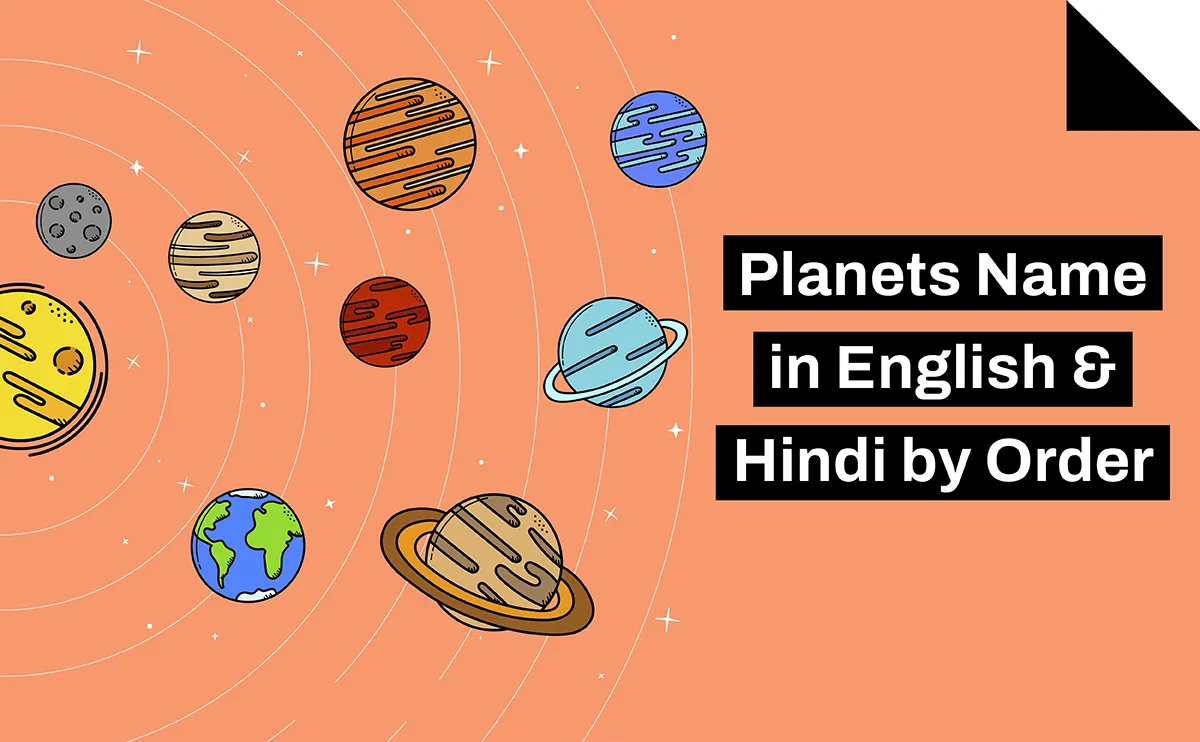
The solar system has eight planets that revolve around the Sun. These planets are Mercury, Venus, Earth, Mars, Jupiter, Saturn, Uranus, and Neptune. Each planet has unique features such as size, temperature, and atmosphere. Students learn these planet names to understand basic astronomy and the structure of space.
Many learners search for planets name in English and Hindi to improve both scientific knowledge and language skills. In Hindi, these planets are known as Budh, Shukra, Prithvi, Mangal, Brihaspati, Shani, Arun, and Varun. Learning both versions helps students connect school concepts with everyday language.
This page provides a clear list of planets name with order, meaning, and key facts. It helps students, parents, and teachers build a strong base in science. The content is simple, accurate, and easy to remember.
Let us learn the names of planets in the solar system in a clear and structured way.
List of Planets in English and Hindi (With Order)

Here are the eight planets name in our solar system listed in order from closest to the Sun to farthest:
- Mercury (बुध – Budh)
- Venus (शुक्र – Shukra)
- Earth (पृथ्वी – Prithvi)
- Mars (मंगल – Mangal)
- Jupiter (बृहस्पति – Brihaspati)
- Saturn (शनि – Shani)
- Uranus (अरुण – Arun)
- Neptune (वरुण – Varun)
Until 2006, Pluto (यम – Yam) was considered the ninth planet, but it has since been reclassified as a “dwarf planet.” The planets names in order helps us remember their arrangement in space.
Must Buy: Key2Practice Children Books
Detailed Information About Each Planet
1. Mercury (बुध – Budh)
Mercury is the First Planet in the Solar System and the closest to the Sun. It’s named after the Roman messenger god because it moves quickly across the sky. In Hindi, it’s called “Budh.” Among all planets name, Mercury completes its orbit in the shortest time.
Key facts about Mercury:
- It has no moons
- It has a very thin atmosphere
- A day on Mercury is 59 Earth days long
- A year on Mercury is 88 Earth days
- Its surface is covered with craters like our Moon
- Mercury’s temperature ranges from very hot during the day to very cold at night
Mercury looks a bit like our Moon because of all its craters. Its surface has many hills and valleys formed by meteorite impacts. When studying the planets name, Mercury stands out for its extreme temperature variations.
Also Learn: Fruits Name in English for Kids
2. Venus (शुक्र – Shukra)
Venus is the second planet from the Sun and is often called Earth’s “sister planet” because of its similar size. In Hindi, Venus is known as “Shukra.” This makes Venus an interesting entry among the planets name to study.
Key facts about Venus:
- It’s the brightest natural object in the night sky after the Moon
- It rotates in the opposite direction compared to most planets
- A day on Venus is longer than its year! (243 Earth days for one rotation)
- Its thick atmosphere traps heat, making Venus the hottest planet
- Venus is covered with volcanoes and lava plains
- It has no moons
Venus is covered by thick yellowish clouds of sulphuric acid that hide its surface from view. These clouds make Venus reflect sunlight very well, which is why it appears so bright in our sky. Among all planets name, Venus is often mistaken for a star due to its brightness.
Also Learn: Animals Name in English for Kids
3. Earth (पृथ्वी – Prithvi)
Earth is our home planet and the only known world that supports life. In Hindi, Earth is called “Prithvi.” When we study the various planets name, Earth stands out as the only one with confirmed life.
Key facts about Earth:
- It’s the third planet from the Sun
- It has one natural satellite: the Moon
- 71% of Earth’s surface is covered by water
- Earth has a protective magnetic field
- It has a perfect mix of gases in its atmosphere for life
- Earth takes 24 hours to rotate on its axis (one day)
- It takes 365.25 days to orbit the Sun (one year)
Our planet is unique because it has liquid water on its surface and oxygen in its atmosphere, both essential for life as we know it. Among the planets name, Earth is special for its biodiversity.
Also Learn: 50+ Colours Name in English & Hindi
4. Mars (मंगल – Mangal)
Mars is the fourth planet from the Sun and is known as the “Red Planet” because of its reddish appearance. In Hindi, it’s called “Mangal.” Of all the planets name, Mars has generated the most interest for potential human colonization.
Key facts about Mars:
- It has two small moons: Phobos and Deimos
- Mars has the largest volcano in the solar system: Olympus Mons
- It has seasons like Earth but they last longer
- A day on Mars is slightly longer than Earth’s (24 hours and 37 minutes)
- A year on Mars is 687 Earth days
- Mars has polar ice caps made of water and carbon dioxide ice
Mars has many interesting features like canyons, dry river beds, and evidence that water once flowed on its surface. This makes scientists wonder if simple life might have existed there long ago. The planets name in hindi and english both reflect cultural significance—Mars or Mangal represents energy and courage.
Also Learn: Vegetable Names in English & Hindi for Kids
5. Jupiter (बृहस्पति – Brihaspati)
Jupiter is the largest planet in our solar system. It’s named after the king of Roman gods, and in Hindi, it’s known as “Brihaspati.” Among the planets name, Jupiter is the true giant.
Key facts about Jupiter:
- It’s a gas giant with no solid surface
- Jupiter has at least 79 moons
- It has a Great Red Spot, which is a giant storm that has been raging for hundreds of years
- Jupiter rotates faster than any other planet (one day is just 10 hours)
- A year on Jupiter is 12 Earth years
- It has faint, thin rings around it
Jupiter’s colourful appearance comes from the different gases in its atmosphere, creating beautiful bands and swirls that are constantly changing. When learning the planets name, children are often fascinated by Jupiter’s enormous size.
Also Learn: Birds Name in English & Hindi for Kids
6. Saturn (शनि – Shani)
Saturn is famous for its beautiful ring system. It’s the sixth planet from the Sun and the second-largest planet. In Hindi, Saturn is called “Shani.” Among the planets name, Saturn is instantly recognizable due to its distinctive rings.
Key facts about Saturn:
- It has the most spectacular ring system of all planets
- Saturn has at least 82 moons, with Titan being the largest
- Like Jupiter, it’s a gas giant with no solid surface
- A day on Saturn is about 10.7 hours
- A year on Saturn is 29.5 Earth years
- Saturn is the least dense planet—it would float in water if there were an ocean big enough!
Saturn’s rings are made up of billions of ice particles, ranging from tiny dust-sized bits to chunks as big as houses. When studying all planets name, Saturn’s rings make it a favourite among children.
Also Learn: Pet Animals Name in English & Hindi for Kids
7. Uranus (अरुण – Arun)
Uranus is the seventh planet from the Sun and was the first planet discovered using a telescope. In Hindi, it’s known as “Arun.” Among the planets name, Uranus has a unique rotational axis.
Key facts about Uranus:
- It rotates on its side, like a rolling ball
- Uranus has 27 known moons
- It has 13 faint rings around it
- Uranus is an ice giant made mostly of water, methane, and ammonia ices
- It appears blue-green because of methane gas in its atmosphere
- A day on Uranus is about 17 hours
- A year on Uranus is 84 Earth years
Because Uranus rotates sideways, its seasons are very strange—each pole gets 42 years of sunlight followed by 42 years of darkness! The planets name with the most unusual rotation is definitely Uranus.
8. Neptune (वरुण – Varun)
Neptune is the farthest planet from the Sun and the fourth-largest by diameter. In Hindi, Neptune is called “Varun.” Of all planets name, Neptune was the first to be discovered through mathematical predictions rather than direct observation.
Key facts about Neptune:
- It was discovered through mathematical predictions
- Neptune has 14 known moons
- It’s an ice giant similar to Uranus
- It appears blue because of methane in its atmosphere
- Neptune has the strongest winds in the solar system (up to 2,100 km/h)
- A day on Neptune is about 16 hours
- A year on Neptune is 165 Earth years
- It has thin, faint rings around it
Neptune’s Great Dark Spot is a giant storm similar to Jupiter’s Great Red Spot, but it appears and disappears over time. Among solar system planets name, Neptune is known for its intense blue color.
Planets Name According to Their Size
From largest to smallest, here are the planets name according to their diameter:
- Jupiter (बृहस्पति – Brihaspati) – 139,820 km
- Jupiter is so big that all other planets in our solar system could fit inside it! It’s made mostly of hydrogen and helium gases.
- Saturn (शनि – Shani) – 116,460 km
- Saturn is known for its magnificent rings that extend thousands of kilometres but are only about 10 metres thick.
- Uranus (अरुण – Arun) – 50,724 km
- Despite its large size, Uranus appears as just a tiny blue-green dot from Earth because it’s so far away.
- Neptune (वरुण – Varun) – 49,244 km
- Neptune’s blue colour is much richer than Uranus, making it stand out beautifully when seen through powerful telescopes.
- Earth (पृथ्वी – Prithvi) – 12,742 km
- Earth is the largest of the rocky planets and the only one with liquid water on its surface.
- Venus (शुक्र – Shukra) – 12,104 km
- Venus is nearly the same size as Earth but has very different conditions that make it impossible for humans to visit.
- Mars (मंगल – Mangal) – 6,779 km
- Mars is about half the size of Earth, but it has some of the largest features in our solar system, including a canyon system that would stretch across the United States.
- Mercury (बुध – Budh) – 4,879 km
- Mercury may be small, but it’s very dense with a large iron core that takes up much of its interior.
When teaching children about the planets name, comparing their sizes helps them understand the scale of our solar system.
Facts About Planets Name
Here are some fascinating facts about how planets name got their names:
- Mercury (बुध – Budh) – Mercury was named after the Roman messenger god because it moves so quickly across the sky. The Hindi name “Budh” is associated with the planet’s intelligence and quickness.
- Venus (शुक्र – Shukra) – Venus was named after the Roman goddess of love and beauty because it shines so brightly. The Hindi name “Shukra” means “bright” or “clear.”
- Earth (पृथ्वी – Prithvi) – The name “Earth” comes from Old English and German words meaning “ground.” The Hindi name “Prithvi” comes from Sanskrit and refers to “the vast one” or “mother Earth.”
- Mars (मंगल – Mangal) – Mars was named after the Roman god of war because of its red colour that reminded people of blood. In Hindi, “Mangal” is associated with strength and courage.
- Jupiter (बृहस्पति – Brihaspati) – Jupiter was named after the king of Roman gods. The Hindi name “Brihaspati” refers to the “lord of prayer” and is associated with wisdom and teaching.
- Saturn (शनि – Shani) – Saturn was named after the Roman god of agriculture. In Hindi, “Shani” is associated with judgment and karma.
- Uranus (अरुण – Arun) – Uranus was named after the Greek god of the sky. The Hindi name “Arun” refers to the reddish glow of dawn.
- Neptune (वरुण – Varun) – Neptune was named after the Roman god of the sea. The Hindi name “Varun” refers to the lord of the oceans in ancient Hindu mythology.
Learning about the origin of planets name connects astronomy with history and cultural traditions.
Mnemonic to Remember Planet Names
Here are some fun mnemonics to help you remember the order of the planets name from the Sun:
English Mnemonic: “My Very Educated Mother Just Served Us Noodles”
- Mercury
- Venus
- Earth
- Mars
- Jupiter
- Saturn
- Uranus
- Neptune
Another English Mnemonic: “My Very Easy Method Just Speeds Up Naming”
Hindi Mnemonic: “बुध शुक्र पृथ्वी को मंगल बृहस्पति शनि अरुण वरुण बताते हैं” (Budh Shukra Prithvi Ko Mangal Brihaspati Shani Arun Varun Batate Hain)
You can also create your own mnemonic using the first letters of each planet name. This makes it more personal and easier to remember! Mnemonics are a fun way to learn the planets name in the correct order.
Conclusion
Learning about the planets name in our solar system opens up a world of wonder and curiosity. By understanding their names in both English and Hindi, we create connections between language, culture, and science. Each planet has its own unique characteristics, from Mercury’s cratered surface to Neptune’s powerful winds.
Our solar system is an amazing place with planets name of different sizes, colours, and features. Some are rocky like Earth, while others are giant balls of gas like Jupiter. Some have many moons, while others have none.
Remember that space exploration is ongoing, and scientists are constantly making new discoveries about our planetary neighbours. By learning these basics about the planets name, you’ve taken the first step on an exciting journey into astronomy. Whether you call it Earth or Prithvi, our home planet is just one small part of an incredible cosmic neighbourhood waiting to be explored!
FAQs
Q1. Why isn’t Pluto considered a planet anymore?
Ans – In 2006, astronomers decided to change how we define planets. Pluto is now called a “dwarf planet” because, while it orbits the Sun and is round, it hasn’t cleared other objects from its orbital path like the eight main planets name have. There are other dwarf planets similar to Pluto in our solar system.
Q2. Which planet has the most moons?
Ans – Saturn currently has the most known moons with 82 confirmed moons, slightly more than Jupiter’s 79. However, astronomers are still discovering new moons around the giant planets name, so these numbers might change.
Q3. Can humans live on other planets?
Ans – Currently, Earth is the only planet where humans can live naturally. Mars is the most likely candidate for future human settlements, but we would need special habitats with air, water, and protection from radiation.
Q4. Why is Venus hotter than Mercury even though Mercury is closer to the Sun?
Ans – While Mercury is closer to the Sun, Venus is hotter because it has a very thick atmosphere made mostly of carbon dioxide. This atmosphere acts like a blanket, trapping heat in what we call the “greenhouse effect.”
Q5. Do all planets rotate in the same direction?
Ans – No, they don’t! Most planets name rotate from west to east, but Venus and Uranus are different. Venus rotates from east to west (opposite to Earth), which means the Sun rises in the west and sets in the east on Venus. Uranus rotates on its side, almost like a rolling ball, so its poles point sideways rather than up and down.
