

Number Names 1 to 100 for Kids: Learn Numbers Easily

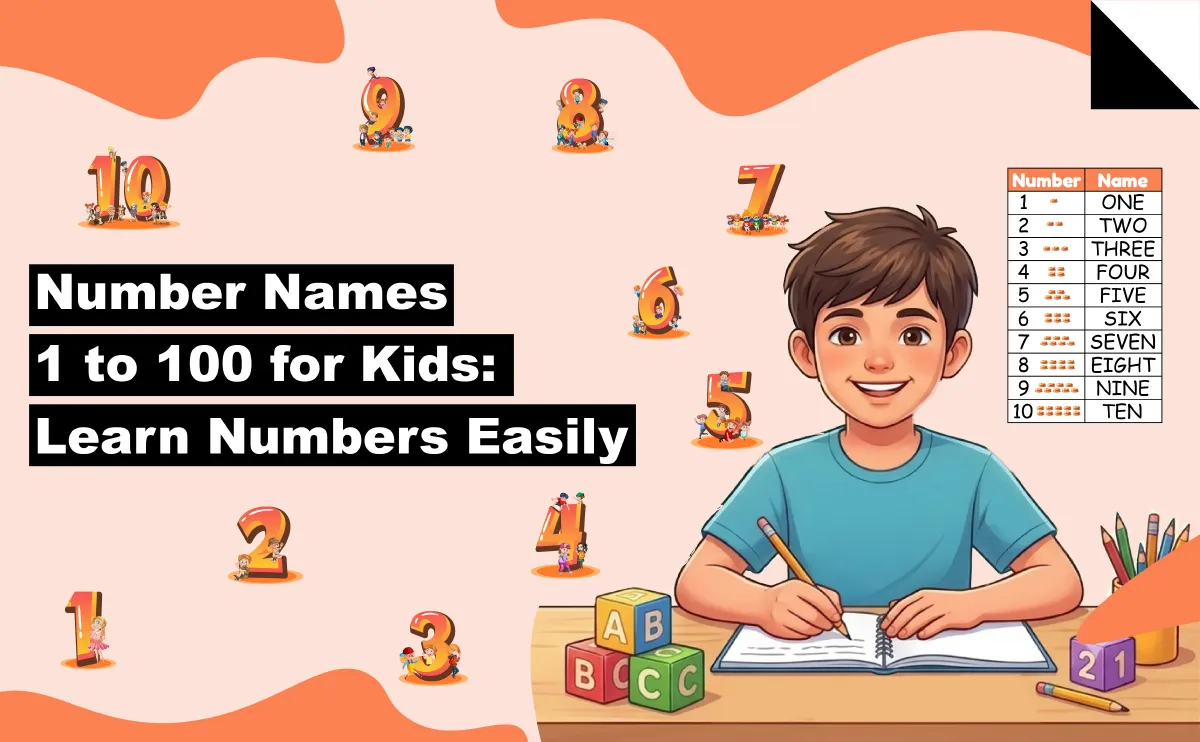
Your child can already count from 1 to 10 using fingers. Now comes the exciting next step: learning to write those numbers as words. Number Names 1 to 100 are the spellings we use when we write numbers in English instead of digits.
This guide gives kids a complete chart, easy spelling rules, fun activities, and step-by-step tips to master number names from 1 to 100 at their own pace. Whether your child is just starting or needs a quick revision before a test, this guide makes the journey simple and enjoyable.
- ▪ What Are Number Names?
- ▪ Number Names 1 to 100 Chart
- ▪ Number Names 1 to 20
- ▪ Number Names by Tens
- ▪ Rules for Writing Numbers in Words
- ▪ How to Teach Number Names to Kids Easily
- ▪ Benefits of Learning Number Names
- ▪ Common Mistakes Kids Make in Number Names
- ▪ Fun Activities to Learn Number Names
- ▪ FAQs
What Are Number Names?
Number names connect the digit we see on paper to the word we say out loud. Once kids understand this link, reading and writing numbers becomes much easier.
- Definition: Every numeral has a word form. Writing 7 becomes “Seven” and writing 42 becomes “Forty-Two.” This word form is what we call a number name.
- Used in everyday life: Cheques, storybooks, price tags, and exam question papers all use number names. A child reads “Page Twenty-Two” in a book, writes “Forty Rupees” in a shop game, or answers “There are Fifteen birds” in a science question. Knowing 1 to 100 spelling in English makes all these moments effortless.
- Builds number sense: Place value becomes easy to grasp through number names. Seeing 25 written as “Twenty-Five” shows instantly that there are two tens and five ones, making addition and subtraction far less confusing.
- Connects maths and English: Maths and English practise happen together when kids study 1 to 100 number names. Spelling “Ninety” correctly helps in English class, and recognising 90 in word form helps in maths, both at the same time.
Example: The number 36 is written as “Thirty-Six” and the number 19 is written as “Nineteen.”
Must Purchase: Oswal Publishers’ Childrens Books
Number Names 1 to 100 Chart
This complete chart is the fastest way to learn and revise all 1 to 100 number names. Keep it on your study table, look at it every day, and test yourself once a week.
| Number | Name | Number | Name | Number | Name | Number | Name |
| 1 | One | 26 | Twenty-Six | 51 | Fifty-One | 76 | Seventy-Six |
| 2 | Two | 27 | Twenty-Seven | 52 | Fifty-Two | 77 | Seventy-Seven |
| 3 | Three | 28 | Twenty-Eight | 53 | Fifty-Three | 78 | Seventy-Eight |
| 4 | Four | 29 | Twenty-Nine | 54 | Fifty-Four | 79 | Seventy-Nine |
| 5 | Five | 30 | Thirty | 55 | Fifty-Five | 80 | Eighty |
| 6 | Six | 31 | Thirty-One | 56 | Fifty-Six | 81 | Eighty-One |
| 7 | Seven | 32 | Thirty-Two | 57 | Fifty-Seven | 82 | Eighty-Two |
| 8 | Eight | 33 | Thirty-Three | 58 | Fifty-Eight | 83 | Eighty-Three |
| 9 | Nine | 34 | Thirty-Four | 59 | Fifty-Nine | 84 | Eighty-Four |
| 10 | Ten | 35 | Thirty-Five | 60 | Sixty | 85 | Eighty-Five |
| 11 | Eleven | 36 | Thirty-Six | 61 | Sixty-One | 86 | Eighty-Six |
| 12 | Twelve | 37 | Thirty-Seven | 62 | Sixty-Two | 87 | Eighty-Seven |
| 13 | Thirteen | 38 | Thirty-Eight | 63 | Sixty-Three | 88 | Eighty-Eight |
| 14 | Fourteen | 39 | Thirty-Nine | 64 | Sixty-Four | 89 | Eighty-Nine |
| 15 | Fifteen | 40 | Forty | 65 | Sixty-Five | 90 | Ninety |
| 16 | Sixteen | 41 | Forty-One | 66 | Sixty-Six | 91 | Ninety-One |
| 17 | Seventeen | 42 | Forty-Two | 67 | Sixty-Seven | 92 | Ninety-Two |
| 18 | Eighteen | 43 | Forty-Three | 68 | Sixty-Eight | 93 | Ninety-Three |
| 19 | Nineteen | 44 | Forty-Four | 69 | Sixty-Nine | 94 | Ninety-Four |
| 20 | Twenty | 45 | Forty-Five | 70 | Seventy | 95 | Ninety-Five |
| 21 | Twenty-One | 46 | Forty-Six | 71 | Seventy-One | 96 | Ninety-Six |
| 22 | Twenty-Two | 47 | Forty-Seven | 72 | Seventy-Two | 97 | Ninety-Seven |
| 23 | Twenty-Three | 48 | Forty-Eight | 73 | Seventy-Three | 98 | Ninety-Eight |
| 24 | Twenty-Four | 49 | Forty-Nine | 74 | Seventy-Four | 99 | Ninety-Nine |
| 25 | Twenty-Five | 50 | Fifty | 75 | Seventy-Five | 100 | One Hundred |
Number Names 1 to 20
Numbers 1 to 20 are the building blocks of all larger number names. Learn these well and the rest of the list becomes much easier to handle.
- Numbers 1 to 9 are unique words: One, Two, Three, Four, Five, Six, Seven, Eight, Nine. Each has its own spelling and must be memorised on its own.
- 11 to 19 follow a “teen” pattern: Eleven and Twelve are special. From 13 onwards, most follow the base number plus “-teen.” For example, Six + teen = Sixteen, and Eight + teen = Eighteen (note the spelling drop).
- 20 is a turning point: Twenty is spelled T-W-E-N-T-Y. Many kids misspell it as “Tweny” or “Twentey.” Writing it ten times by hand solves this quickly.
- Use the split method to learn: Break each word into two parts. For 15, think Five + Teen = Fifteen. This trick works for 13 through 19 and makes 1 to 100 spelling in English much faster to learn.
| Number | Name in Words |
| 1 | One |
| 2 | Two |
| 3 | Three |
| 4 | Four |
| 5 | Five |
| 6 | Six |
| 7 | Seven |
| 8 | Eight |
| 9 | Nine |
| 10 | Ten |
| 11 | Eleven |
| 12 | Twelve |
| 13 | Thirteen |
| 14 | Fourteen |
| 15 | Fifteen |
| 16 | Sixteen |
| 17 | Seventeen |
| 18 | Eighteen |
| 19 | Nineteen |
| 20 | Twenty |
Example: If your child hesitates at 12, ask them to say it in parts: “Twelve.” Point to it on the chart, write it, then cover the chart and write it again from memory.
Number Names by Tens
Tens are the most useful group to learn because they unlock every two-digit number. Once a child knows Thirty and Five, they can write Thirty-Five without help.
Tens from 10 to 100
| Number | Name in Words |
| 10 | Ten |
| 20 | Twenty |
| 30 | Thirty |
| 40 | Forty |
| 50 | Fifty |
| 60 | Sixty |
| 70 | Seventy |
| 80 | Eighty |
| 90 | Ninety |
| 100 | One Hundred |
Common Spelling Rules for Tens
- Forty, not Fourty: This is the most common mistake. The number 4 is “Four” but the ten is “Forty.” There is no “u” in Forty.
- Eighty, not Eightty: Eighty has one “t.” Many kids double the “t” by mistake. Write it as E-I-G-H-T-Y.
- Hyphen for two-digit numbers: All numbers from 21 to 99 (except the round tens) use a hyphen. Write Twenty-One, not Twenty One.
- Combine tens and ones clearly: To write 67, take the tens name (Sixty) and add a hyphen and the ones name (Seven) to get Sixty-Seven.
Also Learn: 100+ General Knowledge Questions and Answers for Kids
Rules for Writing Numbers in Words
Knowing the rules means kids never have to guess. These four rules cover every number from 1 to 100.
Rule 1: Single-Digit Numbers (1 to 9)
- Spell the word exactly: Each digit from 1 to 9 has a fixed spelling. One, Two, Three, Four, Five, Six, Seven, Eight, Nine. These do not change.
- No patterns here: These nine words must be memorised individually. Flashcards work best for this group.
Rule 2: Numbers 10 to 19
- Ten stands alone: Ten is the only two-digit number with a fully unique spelling that does not follow the teen pattern.
- Eleven and Twelve are exceptions: These two do not follow any pattern. They must be memorised as separate words.
- Thirteen to Nineteen follow a pattern: Most use the ones name plus “-teen.” However, watch out for Fifteen (not “Fiveteen”) and Thirteen (not “Threeteen”).
Rule 3: Tens (20 to 90)
- Each ten has its own word: Twenty, Thirty, Forty, Fifty, Sixty, Seventy, Eighty, Ninety. Note that Forty has no “u” and Eighty has one “t.”
- Never write the ones after a tens word without a hyphen: Fifty Six is wrong. Fifty-Six is correct.
Rule 4: One Hundred
- 100 is written as “One Hundred”: Always write the full phrase with both words. “Hundred” alone without “One” is incomplete.
- No hyphen needed at 100: Unlike two-digit numbers, One Hundred uses a space, not a hyphen, between the words.
How to Teach Number Names to Kids Easily
Children Children learn faster when practice feels playful. These four methods make one to hundred spelling in English enjoyable for any age.
Flashcards
- Write digit on one side: Write the number name in large letters on the other. Show the digit and ask the child to say and spell it aloud.
- Start with 1 to 20: Master the first set before adding tens cards, then the full 100.
- Play a matching game: Spread all cards face down and match each digit to its word. Works
well for siblings playing together.
Number Name Songs
- Set numbers to a familiar tune: Singing strengthens recall far better than silent reading. Focus one chant on the tricky 11-to-19 group.
- Repeat daily for one week: Play every morning for seven days and most children can spell all twenty names without the chart.
Tracing Worksheets
- Trace each name three times, then write once: Prioritise Twelve, Forty, Fifteen, and Eighty, the four most commonly misspelled names.
- Correct immediately: Sit beside the child and fix any wrong letter on the spot so the right spelling sticks.
Matching Games
- Two-column match: List numbers 1 to 20 in column one, jumbled names in column two. The child draws a connecting line.
- Use fill-in-the-blank worksheets: Writing the missing word builds spelling confidence. Mark each correct answer with a star sticker.
Benefits of Learning Number Names
Knowing number names is not just a school task. It builds skills that children use every day inside and outside the classroom.
- Strengthens maths basics: When a child reads “Twenty-Five,” they instinctively understand that 25 has two tens and five ones. This understanding makes addition, subtraction, and place value much easier to grasp.
- Improves English spelling: Practising 1 to 100 spelling in English trains children to recognise letter patterns and improves their overall spelling accuracy in writing tasks.
- Builds reading confidence: Number names appear in story problems, instructions, and real-life text. Children who know these names read and understand questions faster during exams.
- Supports memory development: Memorising 100 words in a structured pattern trains the brain to hold and organise information. This memory habit benefits all other subjects too.
Common Mistakes Kids Make in Number Names
Almost every child makes the same set of mistakes when learning number names. Knowing them in advance helps parents and teachers correct them quickly.
- “Fourty” instead of “Forty”: The number four has a “u,” but Forty does not. This is the single most common mistake across all age groups. Write Forty in red on a sticky note and keep it on the study table.
- “Tweleve” or “Twleve” instead of “Twelve”: Children scramble the letters in Twelve. Teach it as one word: T-W-E-L-V-E. No shortcuts or split patterns work here.
- Missing the hyphen in two-digit names: Writing “Twenty One” instead of “Twenty-One” is a spelling error in formal writing. Remind children that all two-digit names (except the round tens) need a hyphen.
- Confusing “Fifteen” and “Fiveteen”: The correct spelling is Fifteen, not Fiveteen. The “ive” in Five changes to “if” to make Fif-teen. Practise this one separately.
- Writing “Eightteen” instead of “Eighteen”: Eighteen has only one “t.” Practise the spelling as a single word so the double-t error does not creep in.
Fun Activities to Learn Number Names
The best way to remember number names is to use them while playing. These activities make practice feel like a game rather than homework.
Coloring and Writing Activity
- Create a number name colouring sheet: Draw 10 large empty boxes on paper. Write a number in each box. Ask the child to write the name inside and colour the box in their favourite shade.
- Colour by number name: Prepare a simple drawing with sections labelled One, Two, Five, and so on. The child must know the number name to choose the right colour for each section.
Bingo and Matching Cards
- Make a 5×5 number bingo grid: Fill each square with a number word from the chart. Call out digits and the child covers the matching word. First to complete a row wins.
- Matching snap card game: Prepare two sets of cards: one with digits, one with words. Shuffle and deal. Players turn cards simultaneously. If a digit matches a word, both players race to slap the pile and call the number name. The fastest player wins the pair.
FAQs
What are number names from 1 to 100?
Number names from 1 to 100 are the word forms of numbers from One to One Hundred. For example, 1 is “One,” 55 is “Fifty-Five,” and 100 is “One Hundred.” They help children read, write, and understand numbers in English.
How do I teach 1 to 100 spelling in English to my child?
Start with numbers 1 to 20, which must be memorised individually. Then teach the tens (Twenty to Ninety) and the rule of adding a hyphen for two-digit names. Use flashcards, songs, and daily chart revision for the fastest results.
Which number names are most commonly misspelled?
Forty (not Fourty), Twelve, Fifteen, Eighteen, and any two-digit name that needs a hyphen are the most common trouble spots. A targeted practice sheet covering these five names solves most spelling problems quickly.
How many times should my child practise number names each day?
Ten to fifteen minutes of daily practice is enough. A short daily session of writing, matching, or quiz play builds stronger memory than one long weekly session. Consistency matters far more than the amount of time spent in a single sitting.
